
30 seconds direct output + native 4K! Seedance 2.5 is here, and the domestic AI video model once again breaks the ceiling
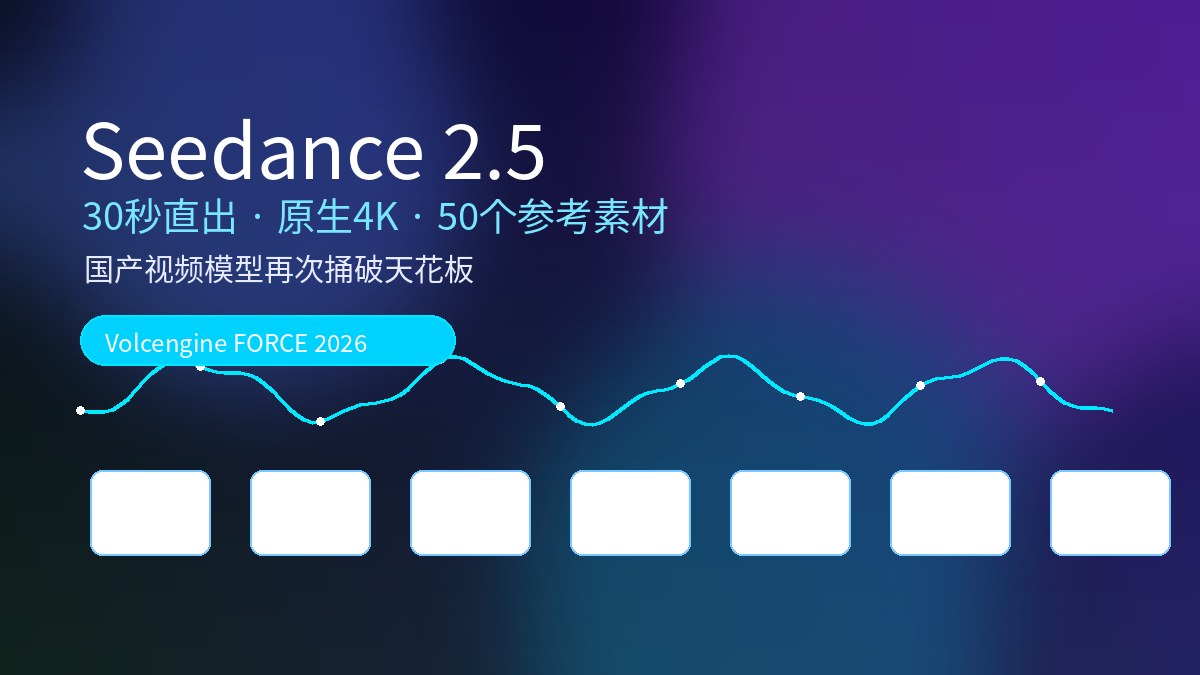
The video generation model track has been taken a big step forward by ByteDance.
On June 23, at the 2026 Volcano Engine FORCE Motive Power Conference, Volcano Engine President Tan Dai officially announced the beanbag video generation model Seedance 2.5. According to multiple media and on-site display information, this version is currently in the global enterprise internal testing stage and is expected to be officially launched in early July.
If you could summarize this upgrade in just one sentence: Seedance 2.5 takes AI video generation from “a toy-like short film of a few seconds” to a “controllable, editable, and commercially usable professional production tool.”
The three most popular keywords: 30 seconds, 50 reference materials, and native 4K.
This is not a decimal point optimization on the parameter table, but a direct hit on the pain points of the video generation industry.
Let me make it clear first: it is not open to all, it is officially launched in early July.
This time Seedance 2.5 was unveiled/announced at the Volcano Engine FORCE conference. It is currently in the global enterprise internal testing stage and is expected to be officially launched in early July.
So strictly speaking, it is not a public version that all ordinary users can directly play today. A more accurate statement is: ByteDance has disclosed the core capabilities of Seedance 2.5 and is entering the final stage before release.
This point must be made clearly, and avoid writing "release notice/enterprise internal testing" as "open to all".
The first cut: a single native 30-second video straight out
The most embarrassing thing about AI video generation in the past was that the time was too short.
Many models can generate 5 seconds, 8 seconds, and 10 seconds, and the effect looks really amazing. However, once you enter the real creation, problems arise: the shot is not long enough, the emotions cannot be spread, the action ends as soon as it starts, and the screen goes black before the narrative begins.
The biggest upgrade of Seedance 2.5 this time is that the length of a single video can be up to 30 seconds, and it emphasizes that a single native video is output directly.
This point is critical.
30 seconds is not just a matter of piecing together several short videos, but the model needs to be maintained in a longer time dimension:
- character consistency
- scene continuity
- action logic
- camera movement
- light and shadow changes
- narrative rhythm
The longer the video, the easier it is for the model to collapse. Character faces change, hands deform, the background drifts, and the camera flies around. These are all old problems in long video generation.
So the real challenge of 30 seconds straight out is not "generate a little more", but long-term timing consistency.
Second cut: up to 50 full-modal reference materials
The second upgrade is more suitable for professional creators: Seedance 2.5 supports the joint input of up to 50 full-modal reference materials.
This means it doesn’t just eat a picture or a piece of text and generate a video out of thin air. It can absorb more reference information and put characters, scenes, styles, compositions, products, actions, lens language and other materials into the generation process.
For commercial videos, this is more important than "looking cool."
Because real commercial creation is not about casually generating a beautiful picture, but must strictly meet:
- The brand color cannot run
- Product appearance cannot be wrong
- The role image should be unified
- The scene style should be continued
- Multiple lenses cannot be separated
- Reference materials given by customers must be used accurately
Supporting 50 full-modal reference materials means that Seedance 2.5 is moving from an "inspiration generator" to a "material-driven production tool."
This is also an important reason why it is oriented to enterprise internal testing: what enterprise users really care about is not how stunning a generation is, but whether it can reuse materials stably, align brands stably, and deliver stably.
The third knife: native 4K, aimed at professional delivery
One keyword appears repeatedly in the scene and search summaries: native 4K.
For ordinary users, 720P and 1080P may be enough to send short videos. But for large screens in advertising, e-commerce, film and television previews, brand videos, and conferences, resolution is a hard threshold.
The significance of native 4K is not only clarity, but also the reduction of secondary losses caused by later amplification, frame filling, and sharpening.
If the AI video model can only be generated at a low resolution, and then relied on super-resolution to increase it, it will easily cause problems such as false textures, blurry edges, messy details, and character skin that looks like wax figures. Native higher resolution output means that the model itself has to handle more complex spatial details during the generation stage.
If Seedance 2.5 is stable in terms of actual usability, it will not only be aimed at short social media content, but closer to commercial-grade video production.
More controllable video generation and editing
In addition to 30 seconds and 4K, Seedance 2.5 also emphasizes more controllable video generation and editing capabilities.
This is equally critical. Because AI video has moved from toys to production tools, the biggest watershed is “controllable”.
It is not difficult to generate a random and good-looking clip, but the difficulty is:
- Change parts without destroying the whole
- Change the characters without breaking the scene
- Change the shot without ruining the action
- Adjust style without losing brand
- Extend clips without losing consistency
For professional creators, the first build is just the beginning, and there will be a lot of adjustments later. If the model cannot be edited, all generated results can only be generated by drawing cards.
Why is it said that it breaks the ceiling again?

The competition among video generation models used to focus on three dimensions: image quality, motion, and duration.
But by 2026, the industry has begun to enter a new stage: simply looking good is not enough, it must be able to stabilize output.
The three upgrades of Seedance 2.5 correspond to the three thresholds of production:
- 30 seconds: Solving the problem of short films and incomplete narratives
- 50 reference materials: Solving the problem of brand, product, role, and style alignment
- Native 4K: Solving the Problem of Professional Delivery and HD Image Quality
This is no longer just "AI helps me generate a cool video", but "AI participates in a real video production line."
Short plays, e-commerce advertisements, game promotions, product videos, urban cultural tourism, industrial displays, film and television storyboards, and educational content may all be reconstructed by this ability.
From Seedance 2.0 to 2.5: Upgrading at a very fast pace
Seedance 2.0 has already made a splash with its video generation effects, and then Seedance 2.0 mini focuses on higher cost performance and large-scale production.
This time 2.5 was announced directly at the FORCE conference, which shows that the Byte Video model route is not a single point of showing off skills, but a product echelon:
- High-quality models: hitting the upper limit of effects
- mini model: reducing costs and scaling up
- Version 2.5: processing time, material capacity, 4K and controllable editing
This combination is about commercialization, not just model rankings.
What it means for the skits and advertising industry
Seedance 2.5 is most likely to hit skits and commercials first.
Why? Because these two industries have three common needs for video: fast, multiple, and cheap.
Short plays need to quickly test themes, characters, covers, and plot hooks; advertisements need to quickly generate multiple versions of materials and invest in different channels, different groups, and different products. Traditional shooting links have high costs, long cycles, and slow changes.
If AI can stably generate 30-second clips and consume a large amount of reference material, the commercial value will be very direct:
- Generate multiple advertisements for one product
- One character generates multiple plot trailers
- A brand vision is extended into multiple scene materials
- Quickly turn a script into a shot sample
- Generate variants in batches of a popular template
This will push video production from "shooting-based" to a new process of "generation + editing + screening + delivery".
Embodied intelligence and industrial scenarios will also benefit

Some reports mentioned that Seedance 2.5 will serve industrial scenarios such as embodied intelligence and industrial manufacturing. This direction is worth looking at.
The AI video model is not just an entertainment tool, it can also be used for:
- Robot task video synthesis
- Industrial process simulation demonstration
- Safety training video generation
- Equipment operation process visualization
- Digital twin scene completion
- Multimodal data enhancement
Especially when the model can understand more reference material and maintain longer temporal consistency, its value will increase in industrial and robotics scenarios.
The war between domestic video models has entered deep waters
In the past, when people mentioned AI videos, they often thought of overseas models first. But now the pace of domestic models has accelerated significantly.
Byte Seedance, Alibaba Wanxiang, Kuaishou Keling, MiniMax Conch, Zhipu/other video generation routes are all constantly closing the gap. The domestic market also has an advantage that overseas models may not have: extremely high density of application scenarios.
E-commerce, short dramas, live broadcast slices, information flow advertising, local life, educational courseware, corporate promotions, these scenarios consume massive amounts of video content every day. Whoever can get through the generation effect, stability, cost, API, and copyright compliance can truly achieve commercialization.
Therefore, the significance of Seedance 2.5 is not just that "domestic models have become stronger again", but that domestic video generation has begun to enter the commercial production chain.
It still depends on the actual performance after opening.
Of course, there is always a layer of reality between the effects of press conferences and the effects of real production.
After Seedance 2.5 is actually launched, there are still several key issues to consider:
- 30 seconds to see whether it is stable in complex scenarios
- Can the 50 reference materials be followed accurately?
- How much does native 4K cost and how fast it is?
- Can video editing achieve precise local modifications?
- Are character consistency and hand details reliable?
- Can API prices support large-scale commercial launch?
- How to deal with copyright, portrait, and material authorization
These issues, more than the conference demo, determine whether it can truly enter the workflow.
How should ordinary creators prepare?

If you are a short video creator, advertising pitcher, e-commerce operator, designer or content team, the most important thing to do now is not to wait for the tool to be released and then conduct temporary research, but to organize your own material assets in advance.
In the future, video generation will not be about taking over the world with just one prompt, but a competition in the ability to organize materials.
It is recommended to prepare in advance:
- Brand visual reference
- Product high-definition pictures
- Character setting diagram
- Scene reference picture
- shot script
- Style samples
- Music and Narration Planning
- Delivery version requirements
When the model supports more reference materials, whose material system is clearer will generate more stable content.
Summary
The release/debut of Seedance 2.5 is a strong signal that domestic video models have entered the professional production stage.
The 30-second single-segment native video is directly played out to solve the problem of narrative length; the 50 full-modal reference materials solve the problem of commercial material alignment; the native 4K solves the problem of high-definition delivery; the more controllable video editing solves the problem of repeated modifications in professional creation.
It does not simply make the video more beautiful, but makes the AI video closer to the real workflow.
The domestic video model has once again broken the ceiling. This sentence is not just an emotion, but the technical route is changing: from card generation to controllable production; from entertainment toys to industrial tools.
Next, it depends on whether Seedance 2.5, after its official launch in early July, can really bring the firepower at the press conference into the daily production of creators and companies.