
Shannon: The 41.4K-Star White-Box AI Pentest Tool
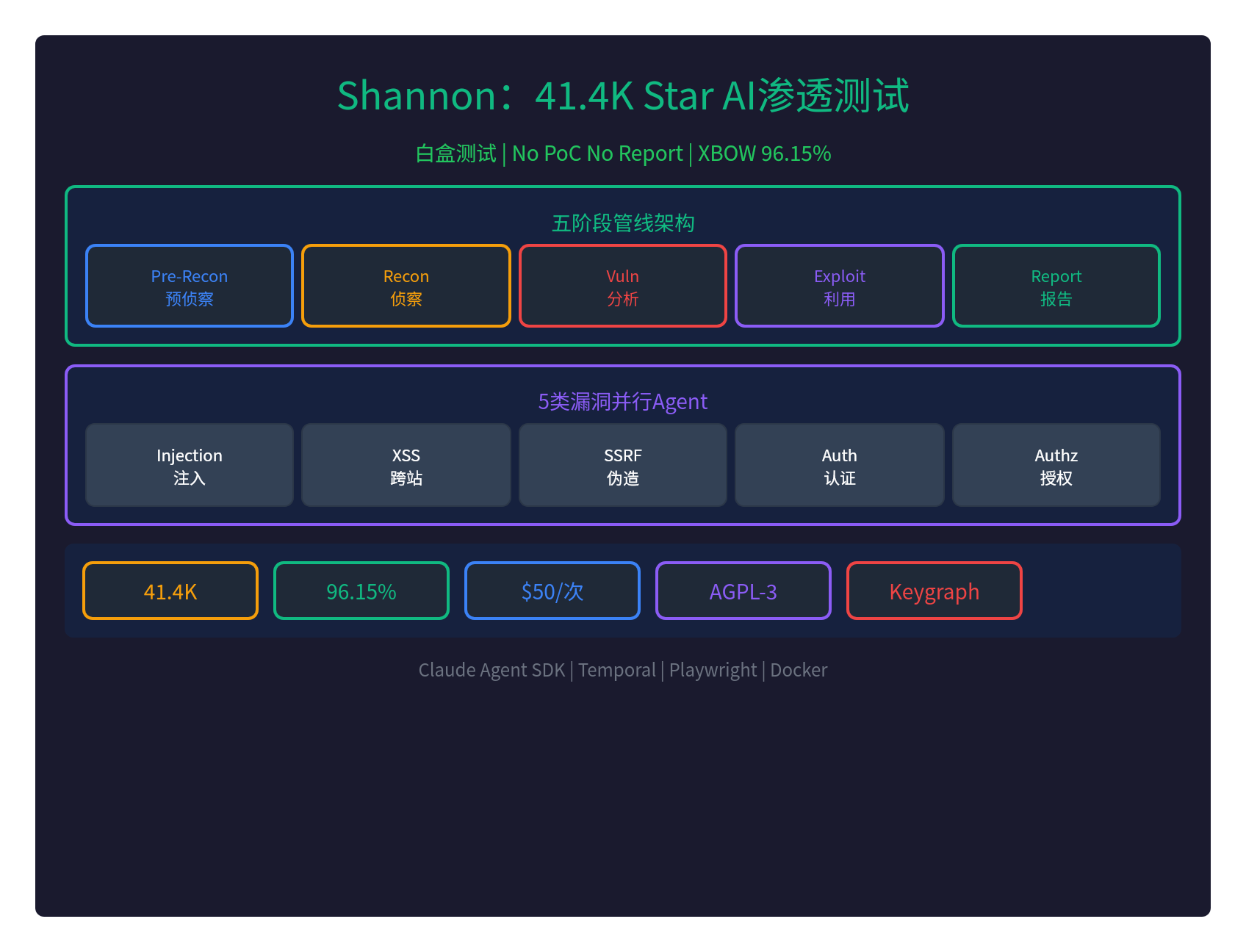
🤖 Shannon: a 41.4K-star white-box AI pentest tool — No PoC No Report
Shannon is an autonomous, white-box AI penetration testing tool for web apps and APIs:
- 41.4K GitHub Stars: one of the hottest open-source projects in security
- No PoC No Report: no PoC, no report — zero false positives
- 96.15% on the XBOW benchmark: an exploit success rate that crushes commercial tools
- $50 per scan: cost per test, with a report in 1-1.5 hours
- White-box testing: needs source code access; source analysis + dynamic attacks
This is the dynamic verification layer of the security toolchain, filling a gap traditional pentesting leaves wide open.
🔍 Why does Shannon exist?
The security gap problem
Your team uses AI coding toolsdeploying code every day, but pentesting happens once a year — who fills the 364-day security gap in between?
- Traditional scanners: dump a pile of “possible” vulnerabilities that security engineers have to verify one by one
- Manual pentesting: takes weeks and costs tens of thousands of dollars
- The security gap: those 364 days in between may be shipping vulnerabilities straight to production
Shannon's answer
Shannon's answer: an agent that reads source code, drives a browser to launch attacks on its own, and refuses to report what it can't exploit — a fully autonomous pentest agent.
⚠️ Not a scanner: No Exploit, No Report
The first step to understanding Shannon
The first step to understanding Shannon is being clear about what it is not:
- Not DAST: not a dynamic application security testing tool
- Not SAST: not a static application security testing tool
- Not pattern matching: not scanning for known dangerous patterns
Traditional tools are essentially pattern matching — scanning code or HTTP responses for known dangerous patterns and spitting out a list of “suspected vulnerabilities.”
Shannon's core design principle
Shannon's core design principle in one sentence:“POC or it didn't happen” (no PoC means it didn't happen):
| Feature | Description |
|---|---|
| Actually launches attacks | : injects SQL, builds XSS payloads, and sends SSRF requests via browser automation |
| Reports only successful exploits | Only successfully exploited vulnerabilities make it into the final report |
| Copy-paste-ready PoCs included | Every finding comes with a PoC you can copy and paste directly |
| No false positives in the report | Unexploitable findings are marked “false positive” or “potential” and excluded from the report |
This means everything a security team receives is verified and reproducible.
OWASP Juice Shop test
In the official OWASP Juice Shop test report, Shannon found 20+ vulnerabilities:
- SQL injection auth bypass(Critical)
- UNION-based data extraction(Critical)
- SSRF(High)
- XSS(High)
- Multiple authorization bypasses(High)
Notably, on two other test targets, Shannon's XSS detection had zero false positives — it correctly identified that those apps had robust XSS defenses and didn't cry wolf.
🔬 Five-stage pipeline architecture
Five-stage pipeline + parallel multi-agent
Shannon's architecture comes down to two keywords: a five-stage pipeline and parallel multi-agent:
| Stage | Name | Description |
|---|---|---|
| Stage 1 | Pre-Recon | : external scanning + source code analysis (Nmap, Subfinder, WhatWeb) |
| Stage 2 | Recon | : bridges static and dynamic analysis, validates endpoints, maps auth flows |
| Stage 3 | Vulnerability Analysis | : 5 parallel agents, each owning one vulnerability class |
| Stage 4 | Exploitation | : 5 parallel agents executing real attacks |
| Stage 5 | Reporting | : generates pentest-grade execution reports |
Underlying reasoning engine
Shannon is built on the Anthropic Claude Agent SDK, with a three-tier model setup:
- Claude Haiku 4.5: summarization
- Claude Sonnet 4.6: security analysis
- Claude Opus 4.6: deep reasoning
📊 5 parallel vulnerability agents
5 independent analysis agents
Shannon spins up 5 independent analysis agents, each responsible for one vulnerability class:
| Agent | Method | Covers |
|---|---|---|
| Injection | : Source→Sink taint tracking | : SQL/command/file/template/deserialization injection |
| XSS | : Sink→Source taint tracking | : cross-site scripting in HTML rendering contexts |
| SSRF | : Sink→Source taint tracking | : HTTP clients, raw sockets, URL openers |
| Auth | : guard verification | : missing security controls (rate limiting, session management, etc.) |
| Authz | : guard verification | : missing authorization checks (horizontal/vertical/contextual) |
The 5 agents run concurrently, without blocking each other. As soon as each analysis agent finishes, its matching exploitation agent kicks off immediately.
Vulnerability classification states
Exploitation agents classify each finding into three states:
- EXPLOITED (exploited): goes into the final report
- POTENTIAL (potential): excluded from the report
- FALSE POSITIVE (false positive): excluded from the report
Only EXPLOITED findings make it into the final report.
🔥 96.15% on the XBOW benchmark
The XBOW benchmark
Shannon scored on the XBOW benchmark with an exploit success rate of 96.15% (100/104):
| Vulnerability type | Total | Success | Success rate |
|---|---|---|---|
| Broken Authorization | 25 | 25 | 100% |
| SQL Injection | 7 | 7 | 100% |
| Blind SQL Injection | 3 | 3 | 100% |
| SSRF / Misconfiguration | 22 | 21 | 95.45% |
| XSS | 23 | 22 | 95.65% |
| Server-Side Template Injection | 13 | 12 | 92.31% |
| Command Injection | 11 | 10 | 90.91% |
| Total | 104 | 100 | 96.15% |
Test conditions
- The XBOW benchmark: 104 intentionally vulnerable apps
- Sanitized versions: variable names, comments, and file path hints removed
- White-box mode: Shannon had access to the app source code
Comparison with commercial tools
- Shannon: 96.15% (white-box mode)
- KinoSec: 92.3% (black-box mode)
- Xfenser AI: 88.5%
- XBOW commercial platform: ~85% (black-box)
💰 Cost and getting started
Cost
Per full scan:
- Time: 1-1.5 hours
- API cost: about $50 USD (based on Claude Sonnet 4.6)
- Range: $40-55, depending on model pricing and app complexity
For comparison traditional manual pentesting: tens of thousands of dollars per engagement, weeks of work.
How to get started
npx mode (recommended, zero install):
# 一次性配置
npx @keygraph/shannon setup

# 运行渗透测试
npx @keygraph/shannon start -u https://your-app.com -r /path/to/repo
Local mode (full build):
# 克隆仓库
git clone https://github.com/KeygraphHQ/shannon.git
cd shannon

# 配置 API Key
echo "ANTHROPIC_API_KEY=your-key" > .env

# 安装和构建
pnpm install && pnpm build

# 运行
./shannon start -u https://your-app.com -r /path/to/repo
Prerequisites
- Docker: container runtime
- Node.js 18+: runtime environment
- Anthropic API Key: recommended
- Source code access: required for a white-box tool
🤝 Shannon Lite vs Shannon Pro
The two editions
| Edition | License | Positioning |
|---|---|---|
| Shannon Lite | AGPL-3.0 | : testing your own apps locally |
| Shannon Pro | Commercial | : organization-wide AppSec platform (SAST + SCA + pentest) |
Shannon Pro features
Shannon Pro is a full-featured application security platform:
- Code Property Graph: static analysis engine
- Business logic security testing: automated invariant discovery
- SCA reachability analysis: CVE reachability tracing
- Secret detection: regex + LLM detection
- Static-dynamic correlation: static findings automatically feed dynamic pentesting
- CI/CD integration: GitHub PR scanning
⚠️ Usage cautions
Important warnings
- Never use against unauthorized systems: Shannon performs real attacks; unauthorized scanning is illegal
- Not recommended in production: the attacks can have destructive effects
- Repos may be prompt-injection vectors for the AI: an officially documented security risk
- Shannon Lite is a white-box tool: it needs access to the source code repo
LLM hallucination risk
Official disclaimer: LLMs can still hallucinate, so humans must verify the legitimacy and severity of every finding.
📝 Summary
Shannon represents an emerging paradigm for security tools:
- No PoC No Report: it only reports what it successfully exploited
- 41.4K stars: one of the hottest open-source projects in security
- 96.15% on XBOW: a white-box success rate that crushes commercial tools
- Five-stage pipeline: Pre-Recon → Recon → Vuln → Exploit → Report
- 5 parallel agent classes: Injection, XSS, SSRF, Auth, Authz
- $50 per scan, 1-1.5 hours: far cheaper than manual pentesting
- White-box tool: requires source code access
No PoC, no report — Shannon turns pentesting into a one-liner.
GitHub:https://github.com/KeygraphHQ/shannon
Website:https://keygraph.io