
Claude Learns to Sleep: AI Memory No Longer Rots
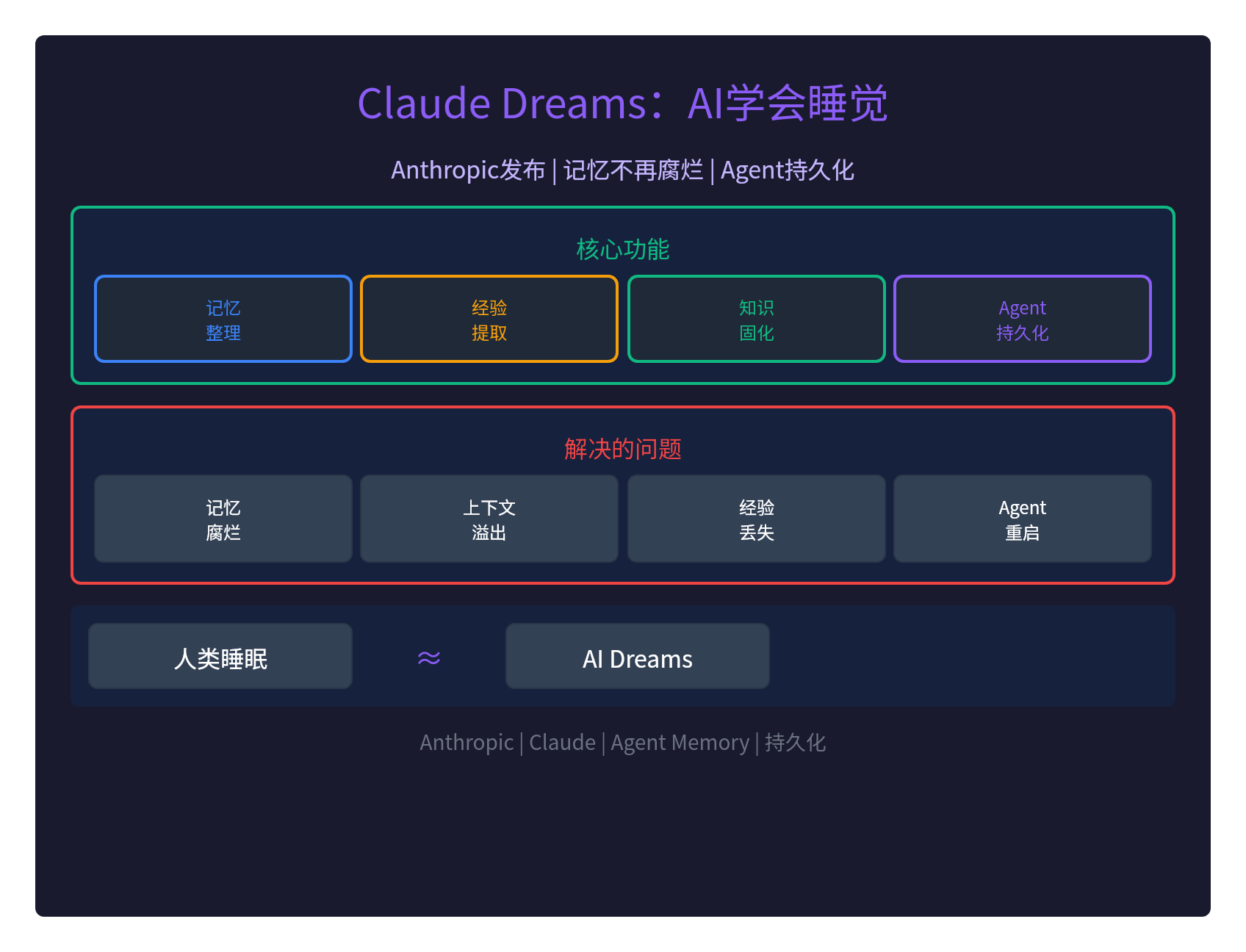
🌙 Claude has learned to sleep: Anthropic launches Dreams, and AI memory no longer rots
Anthropic released Claude Dreams — a feature that lets AI agents “sleep” to tidy up their memory:
- Memory housekeeping: AI no longer “rots” over time
- Experience extraction: distilling key lessons from past conversations
- Knowledge consolidation: turning transient memory into lasting knowledge
- Agent persistence: agents no longer lose their experience after a restart
This is a revolutionary breakthrough in AI agent memory management.
⚠️ The AI memory rot problem
What is memory rot?
AI agent memory has a “rotting” problem:
- Context overflow: anything past the context window gets thrown away
- Lost experience: every restart wipes out everything the agent learned
- Relearning from scratch: each restart means relearning the same things
- Wasted effort: no accumulated experience, forever a rookie
The analogy: human sleep
Human sleep does the following:
- Memory organization: the brain files away the day's memories during sleep
- Experience consolidation: short-term memories become long-term ones
- Knowledge distillation: extracting key knowledge from messy information
- Recovery: clearing out the “garbage” and recharging
AI “memory rot” is simply the absence of a sleep-like memory tidy-up process.
✨ Claude Dreams features
Core mechanism
The Dreams feature lets Claude “sleep”:
| Feature | Description | Analogy |
|---|---|---|
| Memory housekeeping | Sorts through past conversations and pulls out key information | The brain filing the day's memories |
| Experience extraction | Distills reusable lessons from conversations | Consolidating experience during sleep |
| Knowledge consolidation | Turns transient memory into durable knowledge | Short-term → long-term memory |
| Agent persistence | Experience survives restarts, nothing lost | Waking up remembering yesterday |
Workflow
- Conversation build-up: the agent chats with users and accumulates experience
- Dreams trigger: hitting a threshold kicks off Dreams
- Memory housekeeping: sorts through conversation history, extracts key info
- Experience consolidation: writes lessons to persistent storage
- Garbage collection: deletes useless transient memories
- Agent recovery: wakes up with the key lessons intact
💡 Use cases
1. Long-running agent projects
For long-running agents:
- Accumulate experience: build up key lessons as the project goes
- Dreams housekeeping: periodic cleanups that solidify key knowledge
- Restart recovery: bounce back with full project context after a restart
- Continuous improvement: the agent gets smarter with use
2. Personal AI assistants
For personal AI assistants:
- Learn the user: pick up the user's preferences and habits
- Accumulate knowledge: remember the things that matter to the user
- Dreams housekeeping: organizes user info and locks in preferences
- Long-term companionship: knows the user like an old friend
3. Enterprise agents
For enterprise-grade agents:
- Team experience: accumulates know-how from team collaboration
- Process optimization: learns best practices and locks in workflows
- Onboarding: new agents inherit the team's experience
- Organizational memory: company knowledge doesn't walk out the door with people
📊 How it compares to other approaches
| Approach | Persistent memory | Auto housekeeping | Experience extraction |
|---|---|---|---|
| Claude Dreams | ✅ Automatic | ✅ Automatic | ✅ Smart |
| Vector DB + RAG | ✅ Manual | ❌ Manual | ❌ None |
| Session Compaction | ⚠️ Partial | ⚠️ Compression only | ❌ None |
| Memory Plugins | ✅ Manual | ❌ Manual | ⚠️ Basic |
Claude Dreams is a fully automatic, intelligent memory management solution.
🔥 Potential impact
1. Agents that keep evolving
Agents can keep evolving:
- Smarter with use: experience accumulates instead of resetting on restart
- Deepening expertise: builds domain-specific knowledge over time
- Personalization: learns user preferences for a highly tailored experience
2. Lower costs
Cutting agent operating costs:
- Less relearning: no more relearning everything on each restart
- Higher efficiency: accumulated experience means faster work
- Token savings: no need to re-send the same context over and over
3. New business models
New agent business models:
- Experience-rich agents: sell agents that are “seasoned”
- Trained agents: train agents for specific domains
- Knowledge handoff: an agent's experience can be “inherited” by new agents
🤔 Technical speculation
How it might work
Possible technical underpinnings of Dreams:
- Memory extraction model: a dedicated model for pulling out key lessons
- Knowledge graph building: converting conversations into a knowledge graph
- Vector store optimization: intelligently choosing what to persist
- Compression and summarization: squashing long conversations into key takeaways
The OpenClaw connection
How OpenClaw might integrate:
- Memory Embedding: the existing memory feature
- Session Compaction: the existing context compression
- Persistent Memory: persistent memory storage
- Future Integration: may get a Dreams-like feature
📝 Wrap-up
With Claude Dreams, Anthropic lets AI agents learn to sleep:
- No more memory rot: automatic housekeeping and consolidation
- No more lost experience: key lessons survive restarts
- Agents keep evolving: smarter with every use
- Lower costs: less relearning and fewer tokens
- New business models: experience-rich agents
AI finally gets “sleep,” and memory stops rotting.
Anthropic website:https://www.anthropic.com