
Ollama Memory Leak CVE-2026-7482 Reproduced: High Risk
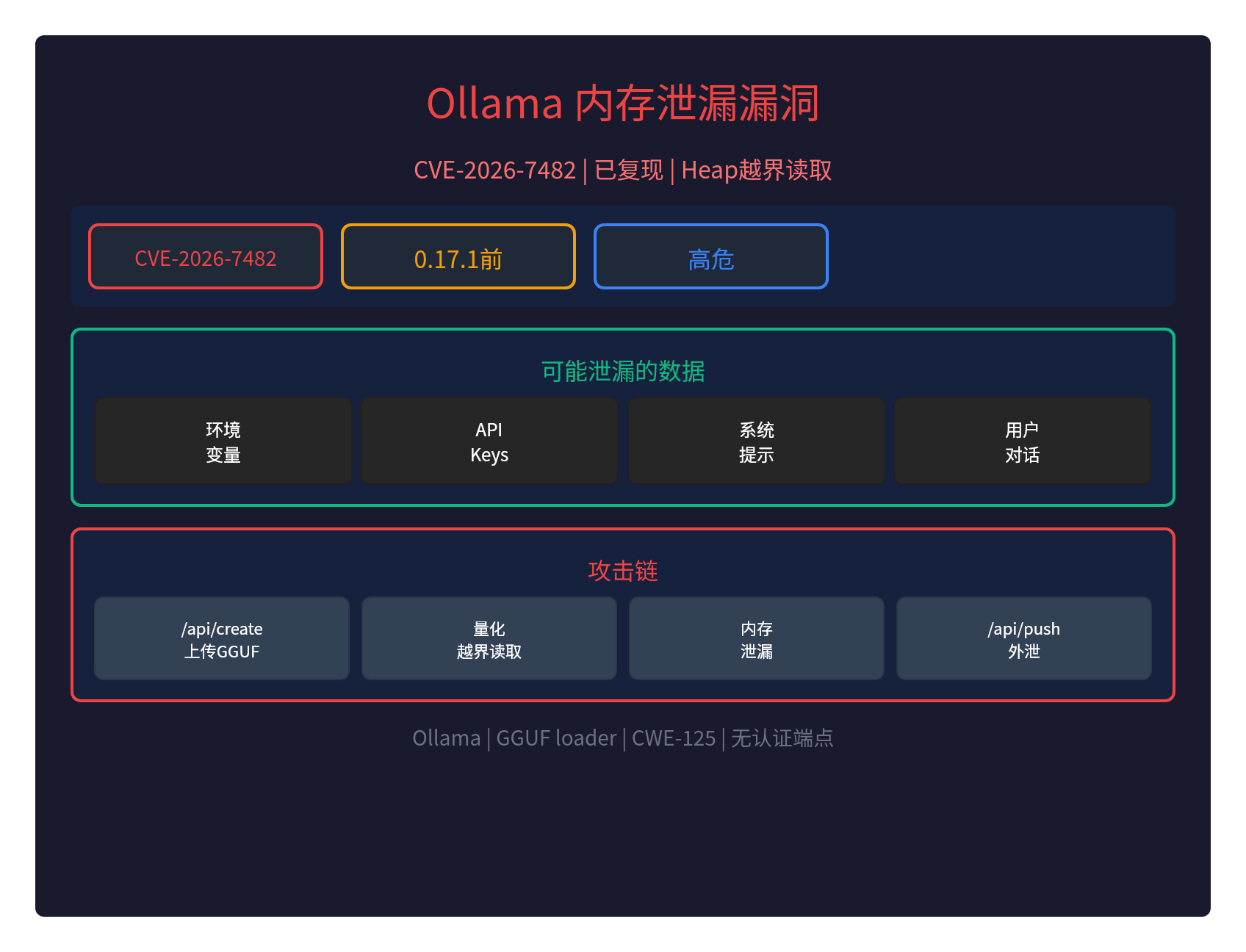
🚨 Ollama memory leak vulnerability reproduced: CVE-2026-7482 is high severity
Security researchers have reproduced the Ollama memory leak vulnerability (CVE-2026-7482), a heap out-of-bounds read vulnerability:
- Affected versions: all versions of Ollama before 0.17.1
- Vulnerability type: heap out-of-bounds read (CWE-125)
- Attack path: /api/create → GGUF loading → quantization → memory leak → exfiltration via /api/push
- Leaked data: environment variables, API keys, system prompts, user conversations
- No authentication: the /api/create and /api/push endpoints require no auth
🎯 The vulnerability at its core
The GGUF model loader vulnerability
The vulnerability is in the GGUF model loader:
- /api/create endpoint accepts attacker-supplied GGUF files
- tensor offset and size exceed the actual file length
- During quantization, reads go beyond the allocated heap buffer
- Location: fs/ggml/gguf.go and server/quantization.go (WriteTo())
What gets leaked
Leaked memory contents may include:
| Leaked data | Risk |
|---|---|
| Environment variables | May contain sensitive configuration |
| API keys | High: exposes API keys |
| System prompts | Exposes internal configuration |
| Other users' conversation data | High: privacy breach |
How data gets exfiltrated
The leaked memory contents can be exfiltrated through the /api/push endpoint:
- Model upload: upload the resulting model artifact
- Attacker registry: push it to a registry the attacker controls
- No authentication: the endpoint is unauthenticated in the upstream distribution
⚠️ Risk level
CVSS 4.0 score
CVSS:4.0/AV:N/AC:L/AT:N/PR:N/UI:N/VC:H/VI:N/VA:H/SC:N/SI:N/SA:N/AU:Y/R:A/V:D/RE:L/U:Red
| Dimension | Score | Description |
|---|---|---|
| Attack vector | Network (AV:N) | Exploitable over the network |
| Attack complexity | Low (AC:L) | Easy to pull off |
| Privileges required | None (PR:N) | No authentication needed |
| User interaction | None (UI:N) | No user interaction needed |
| Confidentiality impact | High (VC:H) | High confidentiality impact |
| Availability impact | High (VA:H) | High availability impact |
📊 Affected deployments
Default configuration
Ollama binds by default127.0.0.1, but the OLLAMA_HOST=0.0.0.0 configuration is widely used:
- Default binding: 127.0.0.1 (local only)
- Public exposure: OLLAMA_HOST=0.0.0.0 (widely used)
- Mass exposure: large numbers of internet-facing instances observed
High-risk scenarios
| Scenario | Risk |
|---|---|
| Internet-exposed Ollama | Critical: directly attackable |
| Multi-user shared Ollama | High: can leak other users' conversations |
| Environments with sensitive API keys | High: API keys can leak |
| Local deployments | in: requires local access |
🔧 Mitigations
Option 1: Upgrade to 0.17.1+ (recommended)
# 升级 Ollama
# macOS
brew upgrade ollama

# Linux
curl -fsSL https://ollama.com/install.sh | sh
What's fixed: the patch fixes the GGUF loader's out-of-bounds read.
Option 2: Limit network exposure
# 不要使用 0.0.0.0 绑定
# 保持默认 127.0.0.1
OLLAMA_HOST=127.0.0.1
Option 3: Firewall restrictions
# 限制 /api/create 和 /api/push 端点访问
# 只允许可信来源
Option 4: Monitor for suspicious GGUF files
- Check GGUF files: verify tensor offsets and sizes are sane
- Monitor /api/create: log the origin of uploaded GGUF files
- Monitor /api/push: log the target registry of uploads
🚀 Reproduction status
Reproduced: security researchers have successfully reproduced this vulnerability:
- Conditions: Ollama < 0.17.1
- Attack path: upload a malicious GGUF → trigger quantization → memory leak
- Leak verified: successfully leaked environment variables and conversation data
- Exfiltration verified: successfully exfiltrated data via /api/push
📅 Patch info
| Item | Link |
|---|---|
| Fixed version | v0.17.1 |
| Patch commit | 88d57d0483 |
| PR | #14406 |
📝 Summary
The Ollama CVE-2026-7482 memory leak vulnerability has been reproduced:
- Affects all versions of Ollama before 0.17.1
- Heap out-of-bounds read, CWE-125
- Leaks: environment variables, API keys, system prompts, user conversations
- Exfiltration path: /api/push uploads to an attacker-controlled registry
- Unauthenticated endpoints: /api/create and /api/push
- Public exposure risk: OLLAMA_HOST=0.0.0.0 is widely used
- Mitigation: upgrade to 0.17.1+ or limit network exposure
A high-severity vulnerability, already reproduced — upgrade or lock down exposure now.
NVD:https://nvd.nist.gov/vuln/detail/CVE-2026-7482
Fixed version:https://github.com/ollama/ollama/releases/tag/v0.17.1