
Apache ActiveMQ High Risk RCE Gap: 5-step completion of attack chain
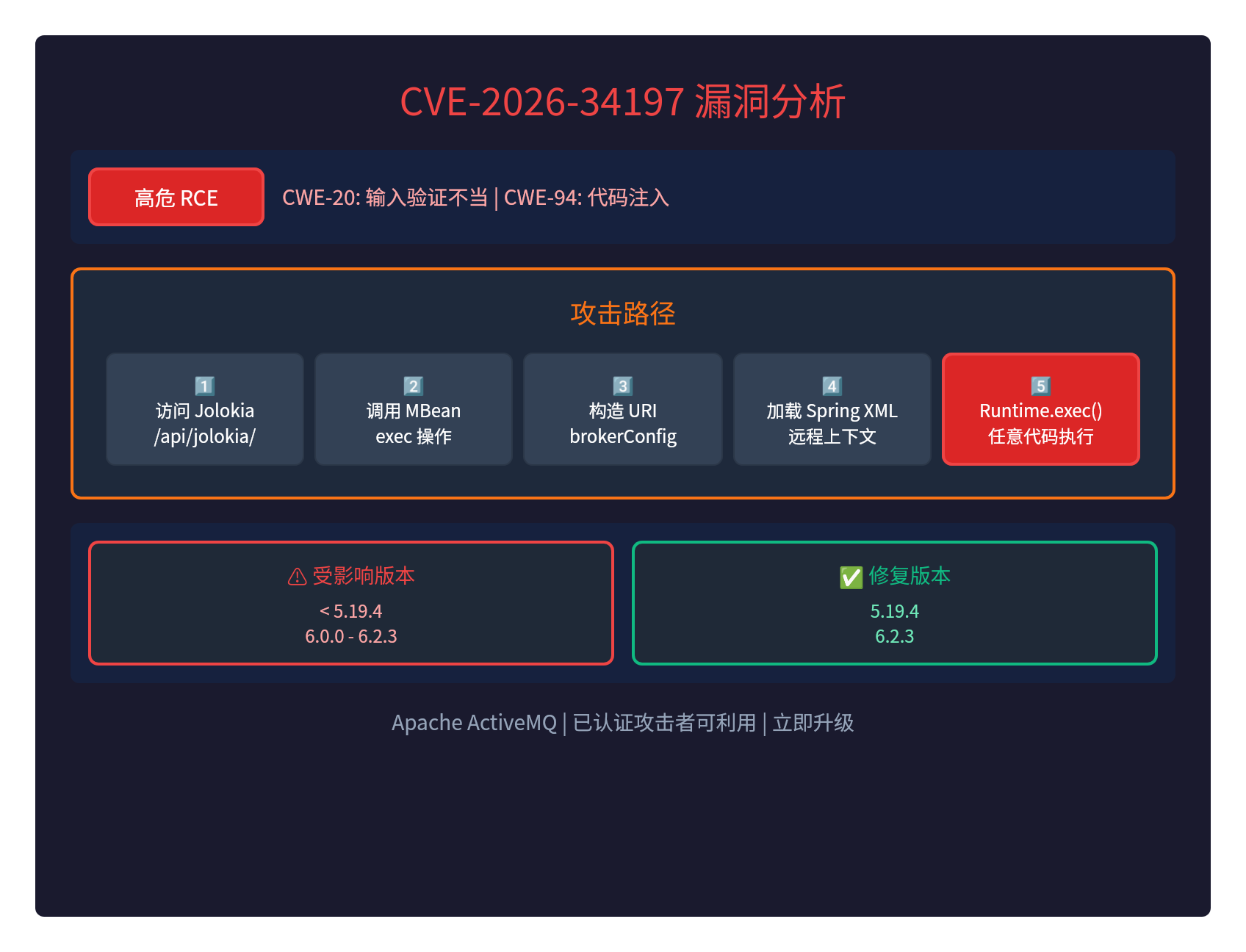
Apache ActiveMQ blasts high-risk RCE loophole
Apache ActiveMQ has recently revealed one.High-risk remote code implementation gap(CVE-2026-34197) The assailant can enforce any code through the Jologia JMX-HTTP bridge on the JVM of Broker.
The impact of this loophole is wide, and all users using ActiveMQ 5.x and 6.x versions require immediate attention.
Basic information on loopholes
| Properties | Details |
|---|---|
| CVE ID | CVE-2026-34197 |
| Serious level | High risk (RCE remote code execution) |
| CWE | CWE-20 (inappropriate input validation), CWE-94 (code injection) |
| Impact Component | Apache ActiveMQ Broker |
| Prerequisite of attack | Require certified users |
• Affected version
- Apache ActiveMQ 5.x: All versions < 5.19.4
- Apache ActiveMQ 6.x:6.0.0 – 6.2.3(excluding 6.2.3)
Rehabilitation version
- Upgrade to 5.19.4(5.x series recovery version)
- Upgrade to 6.2.3(6.x series rehabilitation version)
Hole: Five steps to attack.
Step 1: Visit Jolokia Bridge
Apache ActiveMQ Classic was exposed on the Web console. Jologia JMX-HTTP Bridge, the path is /api/jolokia/I don't know. This bridge allows access to the JMX interface via HTTP.
Step 2: Call Mbean exec operation
Default Jologia Access PolicyAllow all ActiveMQ Mbeans(org.apache.activemq:*) perform exec operations. This means that the attackers can call on a variety of ActiveMQ management methods.
Step 3: Constructing malice
The attackers can call. BrokerService.addNetworkConnector(String) or BrokerService.addConnector(String) The method, into the carefully constructed one.That's right.VM transfer trigger BrokerConfig parameter.
Step 4: Load Remote Spring XML
BrokerConfig parameter specifies the load remote Spring XML Apply Context,use ResourceXmlApplicationContextI don't know.
Step 5: Any code execution
The key points are:RessourceXmlApplicationContext has been exemplified before the BrokerService configurationI don't know. The attacker can use a method like: Runtime.exec() On the JVM of brokerExecute any codeI don't know.
Why is this loophole dangerous?
- You can use it after authentication.: With an ActiveMQ login number, you can launch an attack.
- Full control, broker:RCE loophole means that the assailant has complete control of the JVM of ActiveMQ broker
- Implications: ActiveMQ is a medium for business-level news, and many companies are using it.
- The attack chain is intact.: Call remote Spring XML → RCE from → Mbean, strike path clear
How?
Upgrade Now
# 升级到修复版本
# 5.x 系列
wget https://activemq.apache.org/activemq-5.19.4

# 6.x 系列
wget https://activemq.apache.org/activemq-6.2.3
Interim mitigation measures
If this cannot be done for the time being, consideration may be given to:
- Disable Jolokia: Disable Jolokia JMX-HTTP bridge in ActiveMQ configuration
- Limit Jologia access policy: Modify default policy, disable exec operations
- Enhancing certification security: Ensure that the authentication certificate for ActiveMQ is not disclosed
- Network isolation: Limit access to the ActiveMQ Web console
Check for attack.
- Check the ActiveMQ broker log with an abnormal addConnector/addNetworkConnect call
- Check for Spring XML loading requests from external networks
- Monitor the creation of an anomaly process for broker JVM (Runtime.exec)
Summary
CVE-2026-34197 is oneCase of typical unsafe configuration leading to RCE:
- ActiveMQ default exposed Jologia JMX-HTTP bridge
- Default policy allows exec operations for all Mbeans
- The assailant can load remote Spring XML using the brokerConfig parameter
- Spring exemplify bean before authentication configuration, resulting in RCE
If you are using Apache ActiveMQ, check the version immediately and upgrade it to 5.19.4 or 6.2.3!
High-risk loopholes are repaired without delay.
Official Security Bulletin:https://activmq.apache.org/security-advisors.data/CVE-2026-34197-environment.txt