
Gemini 4 Carbon to get Google back to number one: one, and you won't need it today.
Google has a new model. Beijing time, October 29th, at 1 a.m., the official blog came online with the title "our next fronter model", the first two sales points of the text:State-of-the-art network security capability, and long horizon (long continuous operation) capability.
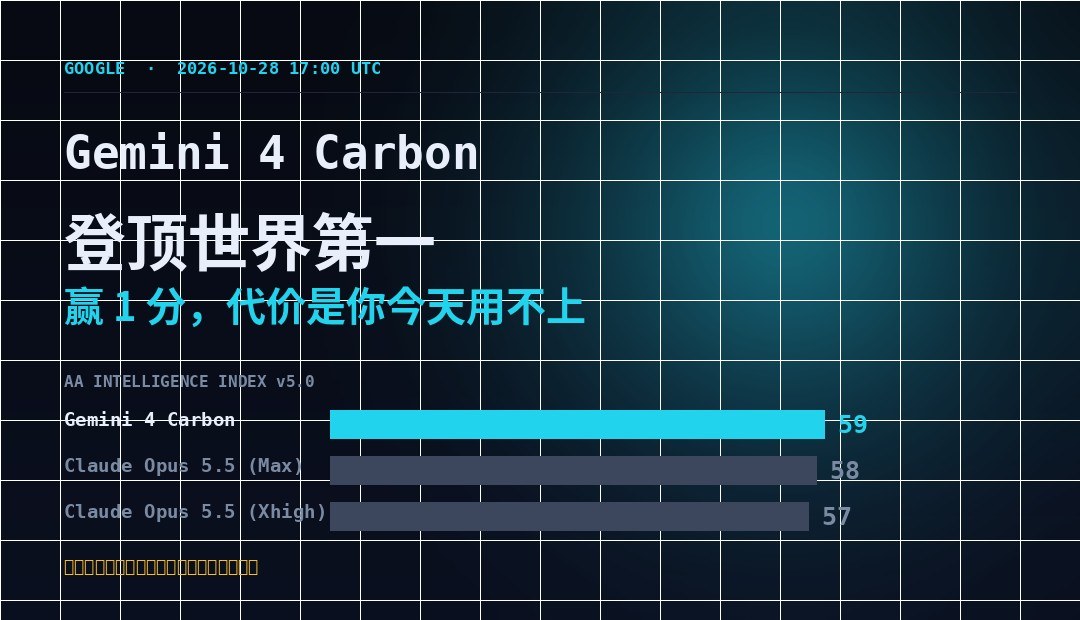
The word "first back in the world" is not empty. Fifty-nine, number one.I don't know. Number two Claude Opus 5.5 Yes 58, and number three is it, 57.
So this isn't going to be the backlash. It's really number one. The problem is...How thick is this "first" and can you touch it?
Two pieces were put forward:Wins the second place 1; the first evaluation in the consolidated list has only four words - no public ability API.All that remained were footnotes to both sentences.
I, say that one.
The list is Artificial Analysis Intelligence Index, which has just been updated to v. 5.0 and which brings together nine assessments: AA-Briefcase, Automation Bench-AAA, Terminal-Bench 4.0, FrontierCode 2.0, AA-Omniscience, GDP.pdf, HLE-Diamond, CritPt v2 (subset of difficulties), Terminal-Bench-Science.
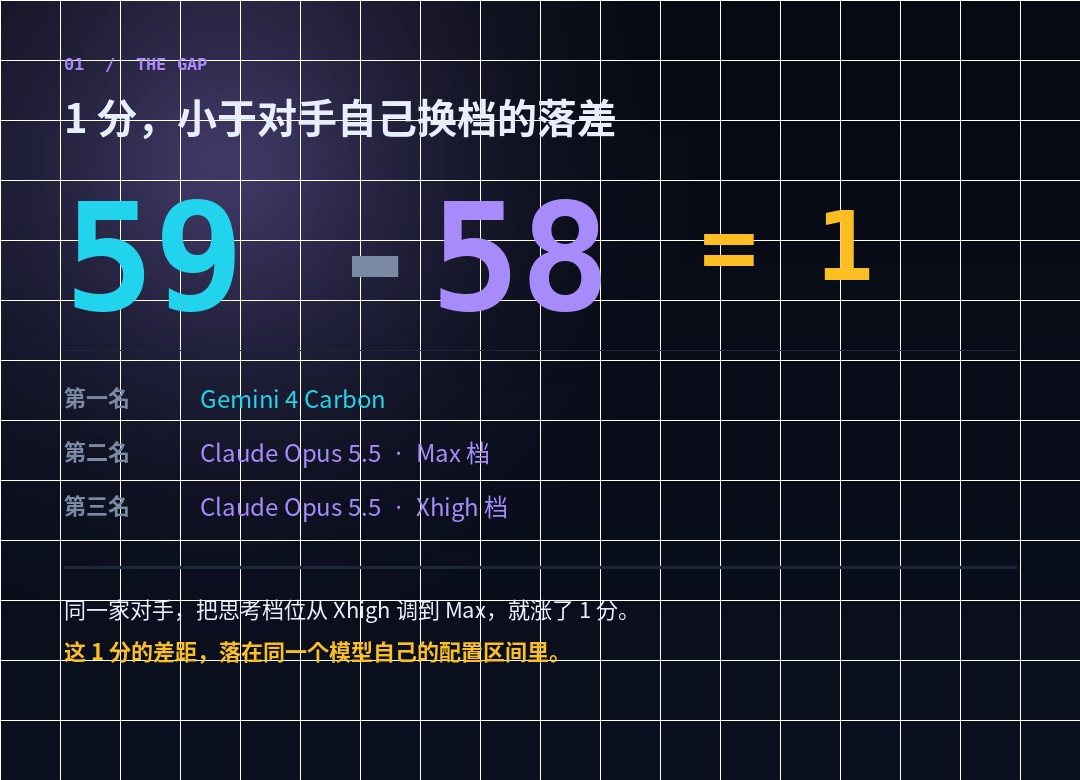
Fifty-eight, fifty-seven. Seeing this sequence, don't celebrate.The second and third are the two reflection stages of the same model.Opus 5.5 takes 58 in Max, 57 in Xheigh.
This sentence is translated:Google's lead this time is smaller than the gap between the other side's thinking depth.
In other words, that's not "generic" but "diverse on the same level." The real meaning is closer: the three are now stuck in the same fractional band, and who gets more training, more math, one day changes order. This has happened more than once this month.
There's one more detail that many people skip:This list is "just updated to V5.0".The evaluation was replaced by a version, and historical scores cannot be directly compared. So the word "return" is not technically valid:It is not possible to compare who is the first in the previous edition and how much less.The first after the change is the first on the new ruler.
ii. The word "publishing" has to be followed by quotation marks.
The title of Ars Technica is simply:"it's the last fronter Ai model that you can't use"- The latest forward model, you can't use it.
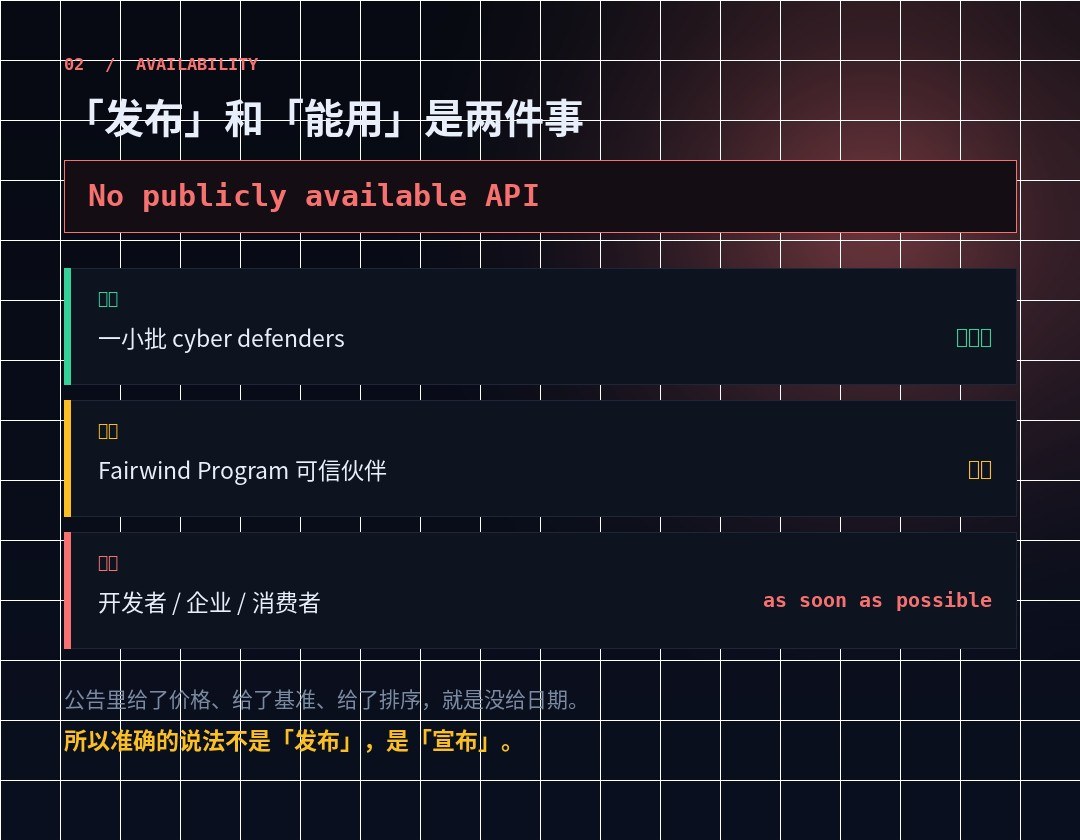
It's not the title party. Artificial Analysis's model page, Gemini 4 Carbon's status is:"No public ability API"I don't know. None of the listed institutions had access to open interfaces and could only be measured in the manner provided by the manufacturer.
Google itself says "deliberate approach to rollout" — deliberately slowing down:
| Time | Who can use it? | Status |
|---|---|---|
| Starting this week. | A small batch of cyber defenders. | Open |
| After | Trusted partners through Fairwind Programme | Gradual release |
| Undetermined | Developer, enterprise, consumer | "as soon as possible" |
The announcement gave price, benchmark, ranking.Only no date.It's not an omission, it's a standard operation: leaving a "soon" there is neither a promise nor a breach.
By the way, Google is also participating in the pre-testing process in the United States Government. This is something to be sure, but it also means one thing:The time to be officially opened to you is not entirely up to Google.
iii. The line with the highest net value:
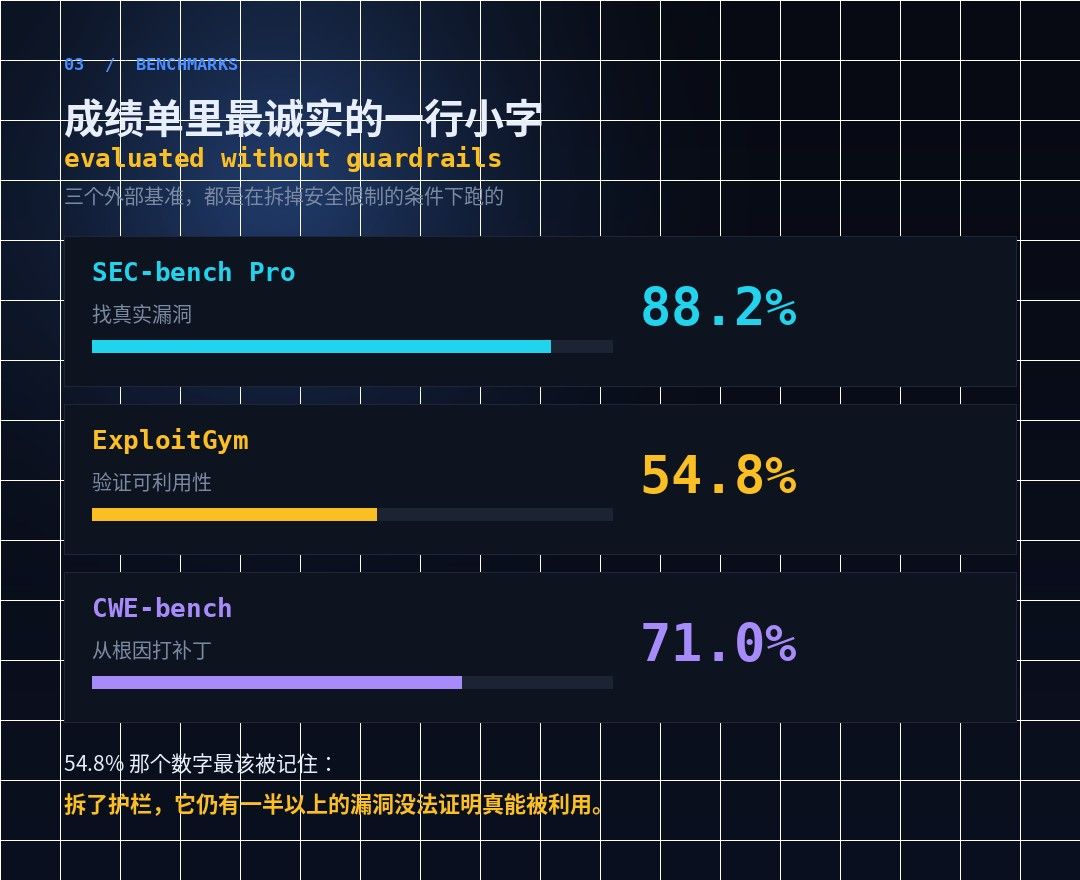
The three external benchmarks, Google's very generous, are both percentages and can be found:
| Benchmark | For what? | Score |
|---|---|---|
| SEC-bench Pro | Look for real holes in real software. | 88.2% |
| ExpressGym | Check if the loophole is being exploited. | 54.8% |
| CWE-bench | Patch from root | 71.0% |
However, there is a bracketed note before the same paragraph, which is very modest:I'm sorry, but I'm sorry."Assessed without the fence."
Why is that important? Because it is an acknowledgement of:These three figures, which are not the capabilities that you can actually use, are the theoretical ceilings that have been removed from the security restrictions.As soon as the fences are put back in the real product, the scores will come down.
More than that, 54.8 per cent of the middle.The fence was removed, and it only proved that more than half of the holes were actually exploited.What's the status of the remaining 45%? Found, reported, but could not prove the consequences — in the management of loopholes, the value of such discoveries would be much less.
I don't think it's a black spot. ExpluitGym is a hard benchmark, 54.8% of which is already the best. But read it as "AI has been able to break most systems automatically" and it's eating those five words.
iv. The only place where Google is willing to lose
The whole bulletin is about first, leading, state-of-the-art. Only one line is the exception:
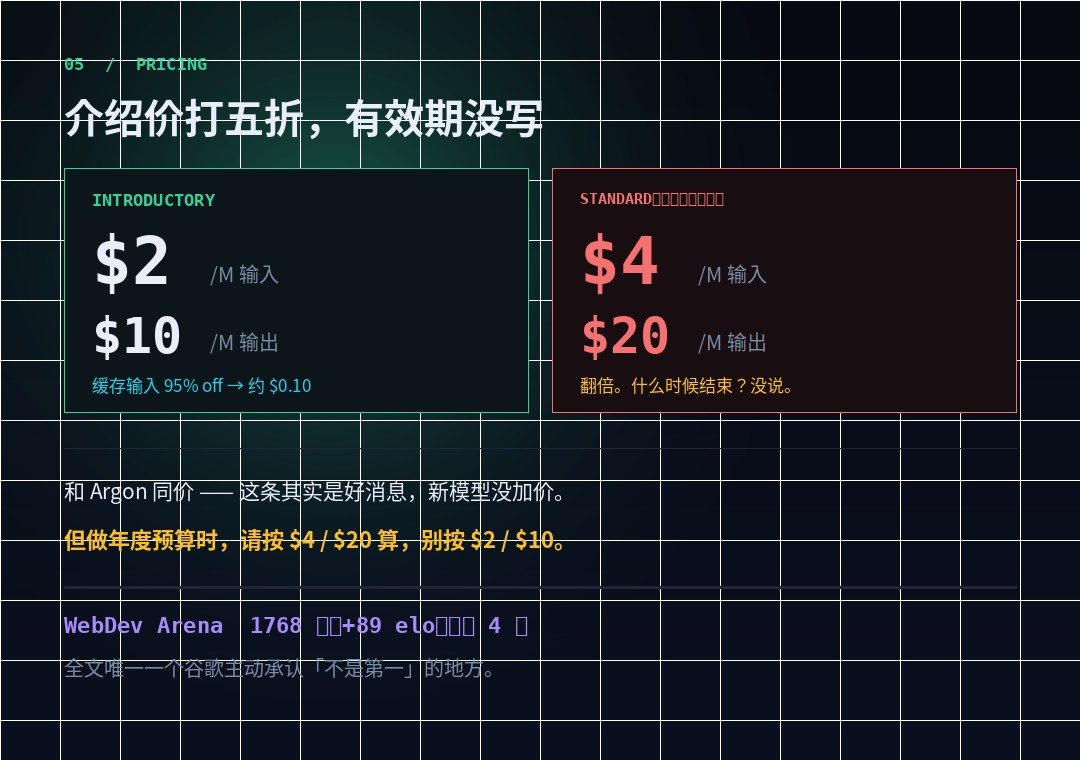
WebDev Arena score 4,1768, up 89 elo.
In this line, I deliberately stayed because it was the only number in the whole text that was "not the first but the only one written." 89 elo's promotion is not small in the arena, but Google didn't wrap it up as "top" because it couldn't be packaged, so it was clear on the list that the white line was 4.
This detail gives me a little more confidence in those numbers:When a company is willing to write number 4 in the bulletin, it knows the reader will look into it.
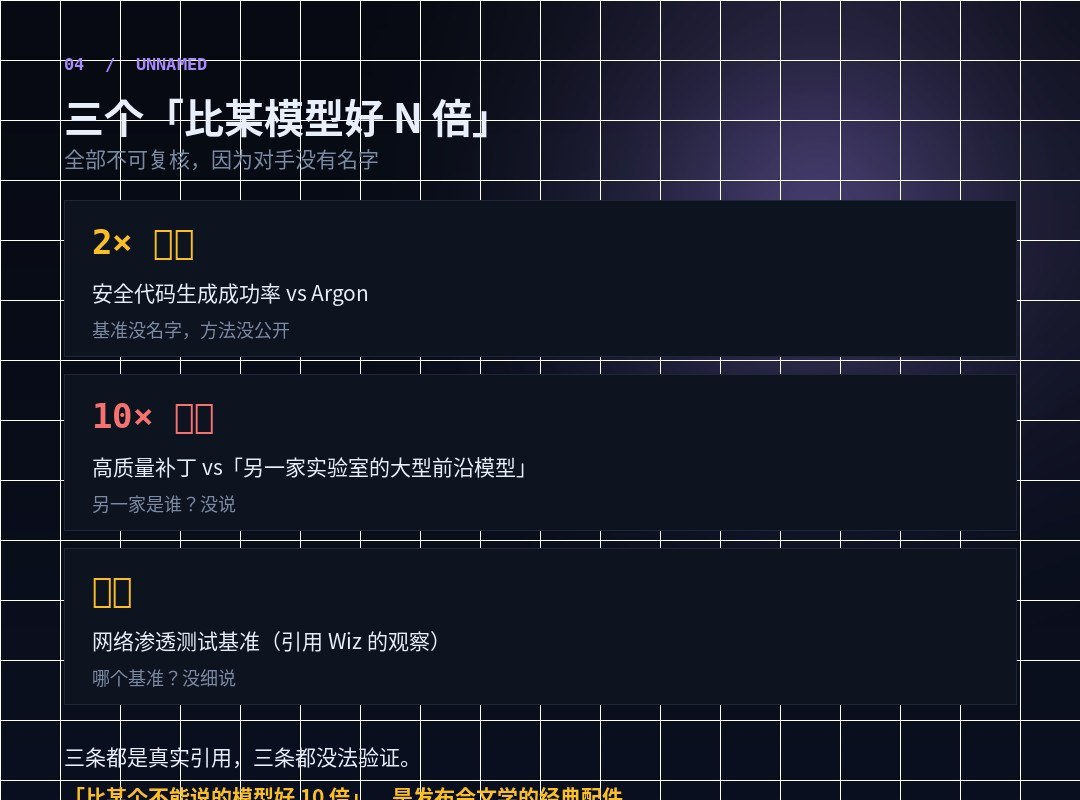
Five, three "better than a model." N, no names.
And here's the part where you're going to throw up. Three of the performance multipliers in the bulletin are as long as this:
- "In the internal benchmark, the security code generation success rate is Argon More than 2 timesWhich internal benchmark? The way is not public.
- "Chrome Team Report, High-quality Patch GenerationIt's more than 10 times the size of another lab.- Who's the other one?
- "Wiz has observed that it is ahead of the Web penetration test benchmark" -- which benchmark? No detail.
"Ten times better than a model that can't be said" is a classic part of publishing literature. It fulfils three conditions simultaneously:It sounds very powerful, can't be perjured and can't take responsibility for the wrong selection of the comparator.
I'm not saying these numbers are made up. The Chrome team and Wiz are real partners, and this internal validation usually runs away. But when it comes to an article,A mix of the external benchmarks and undetectable internal multiplesThe reader's attention is taken away by the latter -- because the latter sounds stronger.That's why it's written in.
Price: 50% discount, valid for confidentiality
This part of Google is finally clean:
| Item | Introduction price | After the presentation period |
|---|---|---|
| Input | $2/ millions token | $4/ million token |
| Output | $10/ million token | $20/ million token |
| Cache Input | Enter the price to play 95% off (approximately $0.10) | Based on new base price |
The two are to be seen separately. The good news is:The new model is the same price as Argon, no price increase.Front-line models were not expensive, and were not common in the two years.
The bad news is:The standard price is twice as high as the presentation price, and the date of the presentation is not in the bulletin.The annual budget is calculated at $4/$20. The figure, calculated at $2/$10, will be returned to work sooner or later.
One more thing to remember:Cache input hits 95% off, or 0.05 times the input price.This discount is now the worst among all mainstream manufacturers. If you have the scene of "the same super-long context," the price structure is real -- if you can use it first.
Seven, the safe part, the numbers are so beautiful.
Google has a set of alignment indicators in the bulletin, which I copied as they are, because they are beautiful:
- Triminal-Bench 4.0 has reduced success rate 0.0%And the cheating attempt dropped to 0.4%, while the accuracy rate increased.
- In the interior disk coding environment, high-risk alert drops.Close to 80%I don't know.
- Unsupported claims are about less than Argon Half.I don't know.
- Crossing (overreach) 26%, under-service 29%I don't know.
- Gray Swan's indirect hint is injected into the baseline. 0.0%(Argon is 0.7%).
0, 0, 80, 50 %, 50 % — these numbers are taken together, which is a question to ask:Why is it all "down" and "zero" and none is absolute?
Because these are...Improvement relative to ArgonAnd Argon was sent two weeks ago. Two weeks.Two weeks to reduce high-risk alerts by 80 per cent, which means that the previous generation was really bad, or that the internal set was far worse than expected.Both explanations are not very good.
I'd like to write half: It clearly states that on the public benchmark of Gray Swan, the zero success rate of the attack means that "all attempts in this version have failed." - Yes, sir.This version of the assessmentI don't know. The offensive is an ongoing confrontation, today's zero percent is not tomorrow's zero percent.
There's one more thing I'm not saying: a two-week generation.
Gemini 4 Argon was released two weeks ago. Carbon built on it.
Google's own words, "Illustrates the place at which we're pushing the front forward" -- show how fast we're moving forward.That is the truth and the problem.
For those who produce, this means:You just put Argon on the line, Benchmark out, prompt out, the next generation is on the way.The model was changed from "annual decision making" to "monthly maintenance". It's not about the Google family, but it's about the most radical.
The same goes for the author. When it came out, the next code number would have been split internally.
Nine, so what do you think of this release?
You should admit it.
- It did take AA Inteligence Index v. 5.0, first, 59 points, for information.
- The line of cybersecurity is really working: the three external benchmarks are the best at the moment, not the words.
- The price structure is restrained in front model.
- The order of giving the defensive side first, then valuing, is logical — the ability to find loopholes is more dangerous to the attackers.
You should've called the question mark.
- One point ahead, less than the difference between the opponent's own thinking slot.This is the sorting in the same horizontal band, not the proxy.
- The list has just been changed to v. 5.0, history is unparalleled."Return Number One" is not methodologically valid.
- None of the three internal multiples have a comparative name.No review is possible and should not be cited as a conclusion.
- The external benchmark was to remove the fence.It doesn't mean you can do it.
- It's 50% discount, but no deadline., double the budget.
We should wait.
- Wait till the public API opens up and runs the real mission. There's a complete evaluation between the score and your job.
- Wait for the third party.Bring the fence.The three security benchmarks are reproduced under conditions.
- Wait till someone puts carbon and Opus 5.5 on the same Max slot -- and now this is 59, right, 58, and the slot is not aligned.
Finally, the title. Google did return to first place this time, and that is not to be. But in the phrase "Return to the world first" there is a less valid assumption:There is a stable, "back" first.
The real state of affairs is that the three families are squeezed in a fractional belt, changing seats every few weeks, each time with a "top-up" announcement.This "first" half-life is probably as long as the next generation.
Winning one point is true. First, it's true. You can't use it today. That's the complete shape of this release.