
What is it? AI Application of Impact Assessment Template Dismantling in Hong Kong's Ethical Artificial Intelligence Framework
Those who do AI governance files probably have seen this word: AIIA -AIアプリケーションインパクト評価I don't know. It is not an academic abbreviation game, but a practical template given by the Office of Digital Policy (DPO) of the HKSAR Government in the Ethical AI Framework Framework to assess the potential impact of AI applications on users and society throughout the life cycle. The first edition of the Framework in April 2021 is currently available in December 2025, in 2.0, and official PDF can be downloaded from digitalpolicy.gov.hk.
I. AIAIA, ITとは?
The official definition is very restrained: AAIIA is used to evaluate AI applications, but it is not the only way to use it.Ensure that the full life cycle impact of AI is managed and relevant AI principles are taken into accountI don't know. It is placed in chapter 5 of the framework, "AI Access", with a complete template in appendix C.
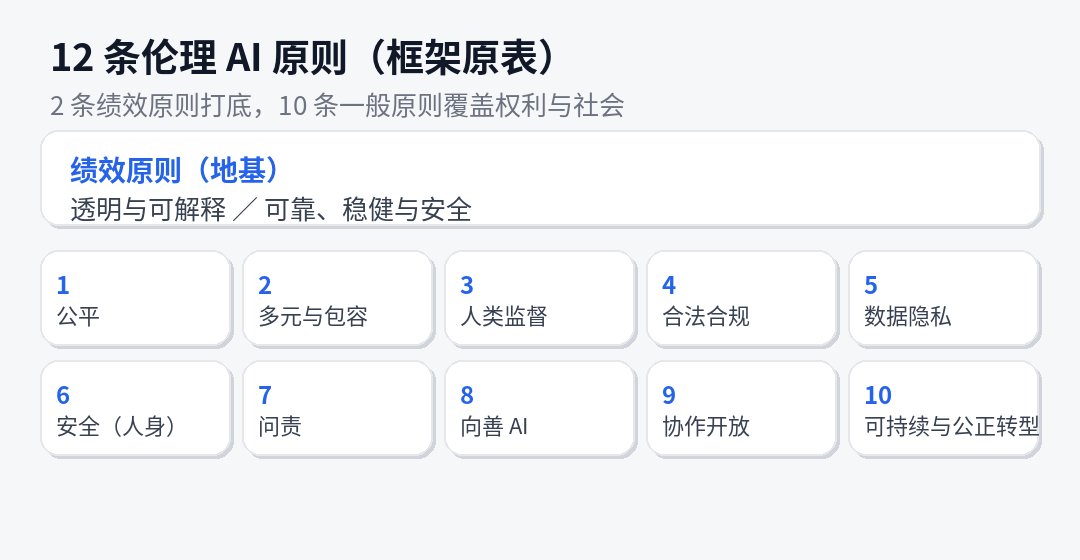
It is based on the 12 AI principles of ethics in the framework. These 12s are in two layers:2 Performance principles(b) (Transparency and interpretability, robustness and security) is the basis of the ground and, failing that, other principles cannot be validated;General principles(Fairness, Plural Inclusiveness, Human Oversight, Legal Compliance, Data Privacy, Personal and Psychological Security, Accountability, Good AI, Collaboration Open, Sustainability and Justice) is traced back to the Universal Declaration of Human Rights and relevant Hong Kong legislation, where data privacy directly corresponds to DPP 1-5, which is the subject of the Personal Data (Privacy) Ordinance.
ii. Not a single tick, but a run with the life cycle
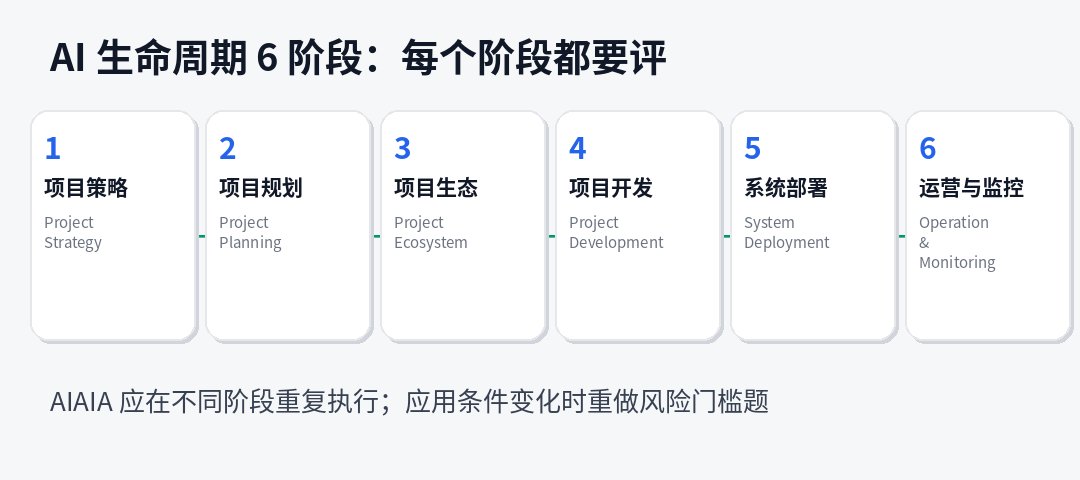
AIIA covers six phases of the AI life cycle: project strategy, project planning, project ecology, project development, system deployment, operation and monitoring. Templates can be updated as a live document throughout the process, but the framework requires 4 Key Nodes for formal reviewState 1 Review (strategy), State 2 Review (planning/analysis design), State 3 Impact Review (deployment), State 4 Post-Release Review (transport), each slot; and to be repeated at least once a year or during major changes.
iii. Template four components and "high risk" Line
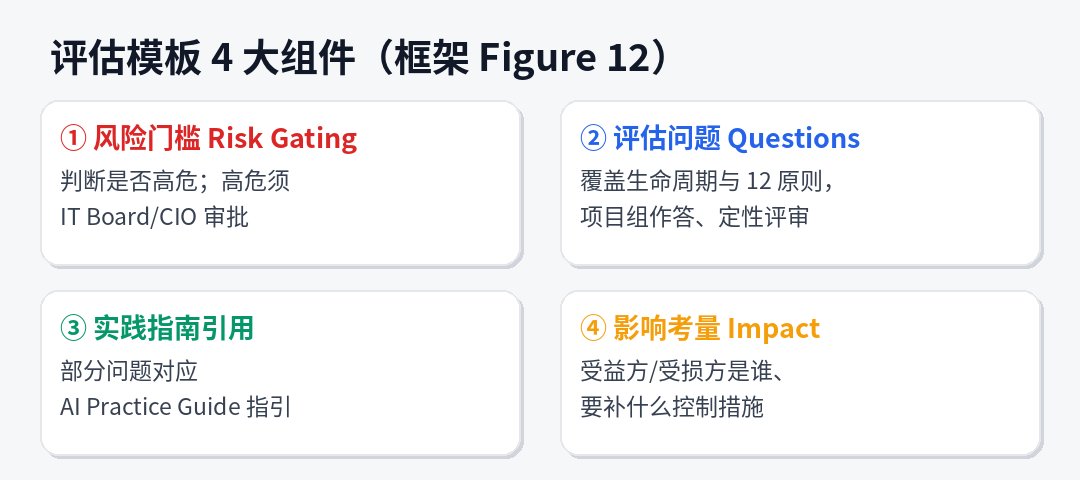
Template consists of 4 components (Framework Figure 5):Risk Gating- プロジェクトチームは一連の質問に答え、プロジェクトを「リスクが高い」または「リスクが高い」と特徴付けました。Assessment issues- Appendix C has a total of 58 questions, which are allocated to project teams by stage, covering life cycle and 12 principles;Reference to the Guide to Practice— 一部の質問は、AIガイドの特定の制御に対応して練習する。衝撃的な考察- Identify who benefits, who damages, what controls need to be added.
The key diversion lies in the approval line: non-high-risk projects are recognized by the Project Steering Committee (PSC/PAT);Once a risk threshold test has been triggered, it is a high-risk application and must be reviewed for endorsement by IT Board/CIOThe third line of defence also requires continuous monitoring of high-risk projects. This is also the difference between AIIA and the Questionnaire — the evaluation findings are directly linked to governance actions.
How to locate this tool
Two reminders: first, the Ethical Artificial Intelligence Framework is a guiding document for the Bureau/Department, and the AIAIA is by its very nature自己評価とガバナンスのフットプリントツールSecond, it is a checklist from an institutional perspective that can also be borrowed from the developers' team — using the 12 principle as an assessment dimension and the risk threshold as a list of red lines in front of the line, more useful than a posteriori ethical statement.
Source: Hong Kong Digital Policy Office, Ethical AI Framework v2.0 (2025-12, first edition 2021-04), digitalpolicy.gov.hk; cross-certification: regulations.ai Hong Kong Framework entry.