
Gemini 4 Argon Release: 1M output token, half price plate Opus, but you can't use it for a while
On 30 September, Google DeepMind officially released Gemini 4 Argon, the official location of the next generation of frontier intelligence. This is the first model of the Gemini 4 series and the first flagship launched seven months after Gemini 3.1 Pro in February this year. In the middle of the period, Google sent out only a few small models of the Flash series, which were once perceived by the outside world as falling out of a front-line model competition. Argon was responding -- it didn't open the door for everyone.
First of all, you can't use it now.
On the day of its launch, Argon was opened only to "credible cyber defences" in the Google Fairwind project. The plan was launched on 2 September and is aimed at Governments and national networking institutions, key infrastructure operators such as medical/telecommunication/energy/finance, core technology platforms and academic laboratories conducting defensive benchmarking tests. Applicants are required to undergo vetting, must use multifactorial fish-resistant certification and must not share or resell access. Officially, there are currently over 650 cooperating agencies.
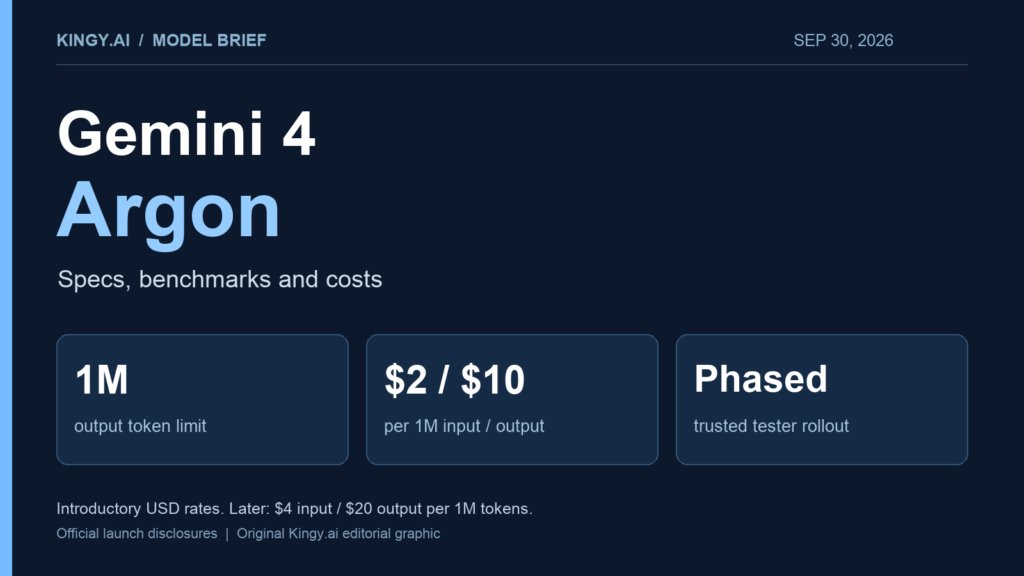
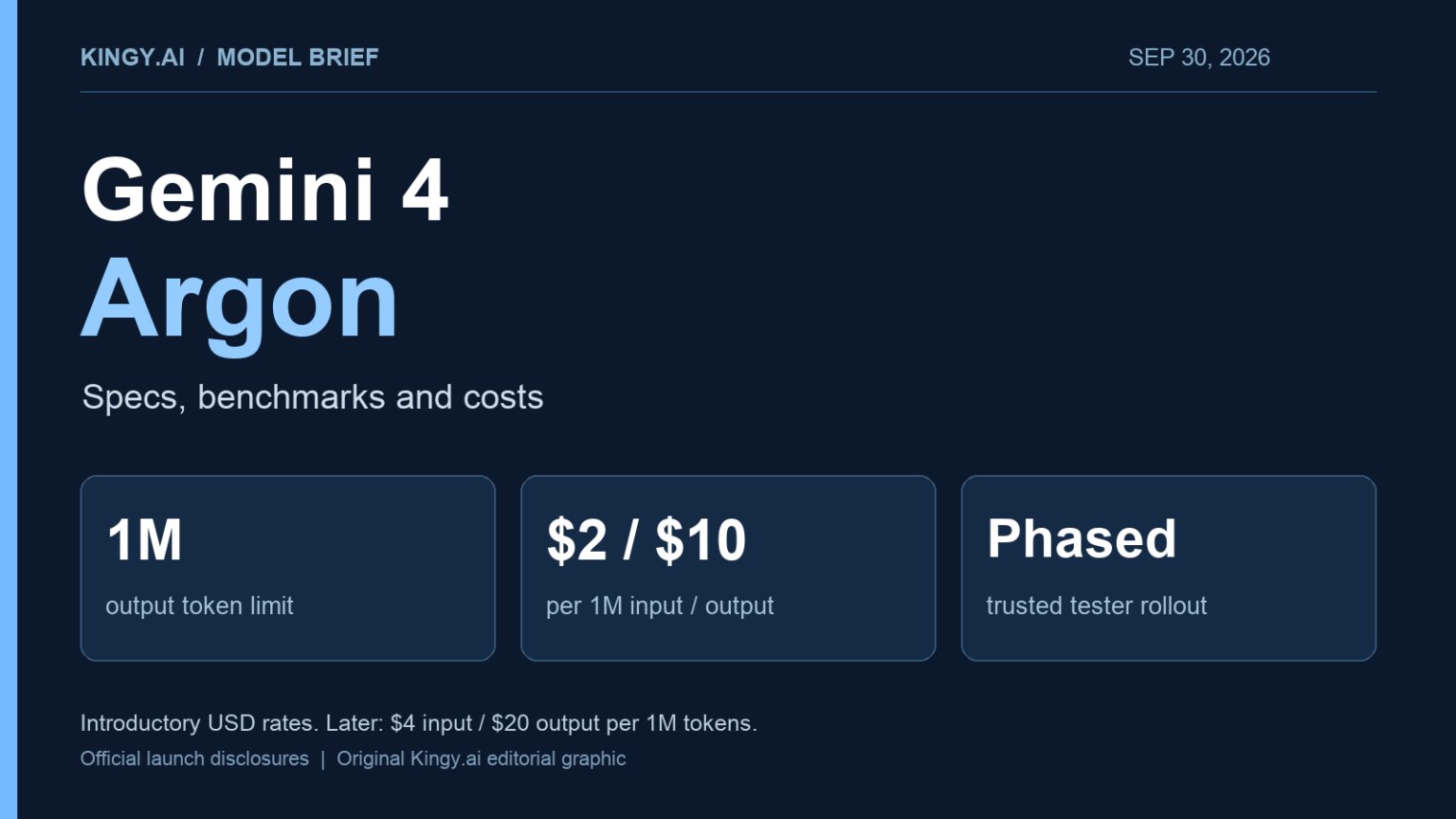
API clients and Google AI Ultra subscribers, then developers, businesses and ordinary consumers, officially called "as soon as possible," butNo date given.I don't know. What's more critical is that we have to be careful.API model ID has not been published to dateThere are no model cards and no knowledge cut-off dates. So you see a price like "$2 input" that can only be understood as an officially published prospective commercial pricing, which doesn't mean it can be called today.
By the way, this is consistent with OpenAI, Anthropic - OpenAI's Daybreak, Anthropic's Project Glasswing, all locking up the strongest cyber security capabilities in the controlled passage. Google also participated in the United States Government's voluntary review process prior to the release of the front-line model.
1M output token: this bet is long
Argon, the hardest technical indicator is not context, but context.Output limit mentioned from 64K 1M tokenAnd Google says it's industry leading. Attention, output, not input.
This difference is important for the person who did Agent. In the past, you were concerned about “how much can be read” and now about “how long can it last?” A large-scale code migration mission may require repeated reading of the warehouse, changes, running tests, reader output, reprogramming and new errors. When the output budget is large, the model does not have to stop early and return control. Google says that when there is space for models to think in depth and generate hundreds of thousands of tokens one step at a meeting on the ability to solve a problem.
But don't take it as a panacea. The high ceiling does not mean that it remembers earlier details, selects the right tools, patches are right and speed is faster. These depend on the context of the input, the Agent framework, the task itself and the authentication link. And a high ceiling allows you to burn a fortune for a failed attempt.Using 1M as the default budget for each request, the rate is not good.It is the task level, the recording of actual consumption and the timely cessation of damage to attempts without measurable progress that are used.
Run score: Win wide, not all.
Google published comparative tables with GPT-6 Astra, Claude Fable 5.1 and Claude Opus 5.5. Integrated media statistics: out of the 18 benchmarks disclosed, Argon was the first of a single 12 and was the first; Astra was the first 3 and Opus 5.5 was the first 2. In other words,The top of the three front-line models, Argon, but the game is still on.I don't know.
Lead places:
- DeepSWE v1.177.9 per cent (real long-cycle software project) higher than 74.2 per cent for Opus 5.5 and 74.1 per cent for Astra
- Vals Index(Financial/programming/legal/tax economic impact as measured by GDP weights in the United States)
- AutomationBech51.3%, first, 8.8 points higher than Opus
- Harvey Law Age Benchmark19.6 per cent, while Astra only 5.4 per cent, Opus 5.5 only 3.8 per cent — an exaggerating rate, but noting that the absolute value is still less than 20 per cent — “a substantial increase from the very low base” can easily appear more certain than it is actually.
- LVBnch91.7%, SOTA
- CWE-bench v168% (facilities repaired), first with Astra
Where it's backward, it's the same:
- FrontierSWE v2Astra 65.5 per cent vs Argon 55.0 per cent, 10.5 points
- Terminal-Bench Science 0.1Astra 68.1% vs Argon 57.6%, same 10.5 points
- Terminal-bench 4.066.4% vs Argon 57.4%, 9 points
- PostTrainBench: Obus 49.3% vs Argon 45.3%
That's why choosing who still depends on what you do. DeepSWE's lead does not mean FrontierSWE is in the lead, with two sets of benchmarked warehouses, mission lengths, language, tool behavior.If your load is more like FrontierSWE or terminal-intensive tasks, there is no reason to move Astra and Opus out of the candidates.
The third party, Artificial Analysis, gives Inteligence Index 53 points, which is the same as GPT-6 Astra and lags behind Claude Opus 5.5 and Sonet 5.5; by contrast, Gemini 3.1 Pro is 30. Fello AI also mentioned it was in the head model tested by Artificial Analysis.The lowest hallucination rate.Yeah. At the same time, Bloomberg reported that some Google staff felt that they were still struggling with real programming.
Google is already using it heavily
Several internal cases have been cited, the most informative part of the text, as they are the landing of the real production environment rather than laboratory runs:
- Quantum algorithm optimizationHelping quantum calculator teams to optimize time and space resources (qubit x gate) for critical applications, one case exceeding the published baseline in minutes 40%
- Memory Efficiency: a group of Argon Agent analyzes the entire fleet profiling telemetry, automatically identify and apply memory optimization, release more than 300 TiB RAM after spread, and expect total savings of 500 Tib to 1 PiB
- C/C++ Turn Rust: From the tens of thousands of lines in core libraries such as re2, libgav1 to more than 800,000 lines in the Fuchsia OS Zircon inner core. These systems are so critical that large-scale rewriting takes a strict automated approach to manual auditing, simulation testing and evaluation before production.
The most specific is libgav1-Google Open Source Video decoder. Argon Agent takes over an existing Rust port, which is exported through multiple rounds of profile-guided experiments and research compilers.Replaced 32K Line SIMD Code, the output compiler can automatically quantify the security of Rust. The result is a secure memory decodor, compared to the original Rust port VersionCome on, 2.7 times.The video output is exactly the same.
Cybersecurity: Argon's second main battleground
Argon has been trained for cyber security.Self-detect, validate and repair key software omissions HoleI don't know. To a credible defensive and Google internal team, Google willTake off the security fence.Send it and give them all forward defense capabilities.
Discovered performance: Wiz through its Scan for Good plan to protect critical public infrastructure free of charge with Argon, modeled onThe medical software used at the Global Hospital found a serious loophole that exposed sensitive personal information, and none of the previous front-line models found it.I don't know. In addition, Argon found exposures in a complex code repository spanning 20 programming languages on a composite gap benchmark within Google; and in Wiz on a black box penetration test benchmark, it exceeded Gemini 3.8 Flash Cyber on the discovery of attack surfaces, identifying loopholes, and producing PoC evidence.
The first delivery of the Fairwind project was Gemini 3.8 Flash Cyber with the CodeMender framework, which helped the defensive to identify, validate and repair the loopholes.
Pricing: Half price starts, then double
The introduction price is...Token 2 dollars per million, output 10 dollars95% discount on input price for cache input, which is about $0.10/million cache inputI don't know. Increase to the end of the introduction period US$ 4 input / US$ 20 output, the cache input is about $0.20. Google does not say how long this “incorporation period” is, however, the industry practice is that — and sometimes — this “sold price” will remain the official price.
Put it in the same price sheet: Argon in the introduction period is GPT-6 Astra ($10/50).One fifth.Claude Opus 5.5.Half.I don't know. This priced to Google two different stories... The promotion period is one of the cheapest head models, and the promotion ends at the same price as Opus 5.5.
Security gate before release.
Google added forward security measures in four directions:
- Prevention of abuseDesigned to reject harmful networks and CBRN requests while retaining legitimate dual-use research; improved technology for internal activation of surveillance models to identify misuse. The fence was tested with a manual + automated attack method by internal and external red teams.
- Precautionary injectionGoogle describes Argon as "the most resilient model to date to inject indirect tips". Gray Swan 's IPI benchmark success rate 0.7%Compared with 1.0% for Opus 5.5 and Fable 5.1, 8.5% for GPT-6 Astra, 27.0% for GPT-6 Sol, 5.3 31.5% for GLM, and up to 51.8% for Grok 4.8 - It's quite a gap.
- Monitor target deviation.: Monitor the thought chain and actions of Argon and interrupt execution if necessary. Google used a similar system during the training process to alert specialized emergency response teams and deliberately avoid re-routing detections to shape the reasoning that would circumvent surveillance.
- Reinforcement System: Segregation and storage of sandbox environment prior to the start of high-risk training or assessment, as per the Agent Control Road Map
The article "Intentionally failing to feed surveillance findings back to training" is one of the most beautiful words of the bulletin: It points to a real problem: if you train models with surveillance results, models may learn “how not to be detected by surveillance” rather than “how not to be dispersed”.
What about this release?
For companies, the point of this release is not to be another chat robot, but to Google, after several months of pressure from OpenAI and Anthropic, to re-prove that he's still at the front table. It's chosen three drops -- software development, professional expertise, network security. - That's exactly where businesses are already spending money.
But it does not need a “win-win” to change the pattern of competition.In 18, the lead or 13 parallels are enough to get Google to advocate for its "widening lead"And the ones that it lags behind — FrontierSWE v2, Terminal-Bench Science, Terminal-Bench 4.0 — also reminds you that OpenAI and Anthropic still have clear technical areas.
The practical conclusion is only one sentence:The model is still dependent on your workload.Take your real job to the pilot, and don't take a nice rundown. The real watershed is when Argon is open to developers, businesses and consumers — that's when the release moves from news to productivity.
There's no end to the front, only the next round.